
A new oospecies of Faveoloolithidae from the Xixia Basin, Henan Province, China and the revision of Parafaveoloolithus
QING HE, SHUTONG LI, SHUKANG ZHANG, YIFAN HUANG, XIQIANG CAO, HONGQING LI, and MENGYUAN ZHU
He, Q., Li, S., Zhang, S. Huang, Y., Cao, X., Li, H., and Zhu, M. 2025. A new oospecies of Faveoloolithidae from the Xixia Basin, Henan Province, China and the revision of Parafaveoloolithus. Acta Palaeontologica Polonica 70 (4): 795–810.
Parafaveoloolithus is an oogenus within Faveoloolithidae, comprising oospecies with uncertain parataxonomic status due to ambiguous microstructures. The revision of problematic taxonomy and the identification of new materials in Parafaveoloolithus can make the classification of Parafaveoloolithus more accurate. Here, we described a new clutch containing 13 dinosaur eggs from the Upper Cretaceous Zhaoying Formation in the Xixia Basin, Henan Province, China by macroscopic measurement and microscopic observation (PLM, CL and SEM). Compared with other oogenera of Faveoloolithidae, these specimens could be assigned to Parafaveoloolithus based on the subspherical shape, columnar eggshell units and partially developed secondary eggshell units. A new oospecies of Parafaveoloolithus, Parafaveoloolithus xixiaensis, was further erected on the basis of the subspherical shape (average 84 in shape index), small size (average 132.4 mm in length and 111.3 mm in width), the parallelly arranged slender eggshell units with a width of 0.05–0.11 mm and wide pore canals with a width of 0.10–0.23 mm in the radial sections, as well as the honeycomb-like structure in the tangential sections. Radial sections of P. xixiaensis oosp. nov. show a single structural layer composed of columnar eggshell units and straight pore canals; some secondary eggshell units are present in the radial sections. The parataxonomy of Parafaveoloolithus guoqingsiensis is revised to Propagoolithus guoqingsiensis based on the branched eggshell unit and smaller pores near the outer surface of the radial section, and the smaller eggshell thickness. Duovallumoolithus is considered an invalid oogenus in Faveoloolithidae, and Duovallumoolithus shangdanensis is assigned to the new combination Parafaveoloolithus shangdanensis. The geographic distribution of Faveoloolithidae is mainly restricted to China, Mongolia and South Korea of East Asia, and P. xixiaensis oosp. nov. provides new material and a complete clutch of Parafaveoloolithus. The assignment of Parafaveoloolithus provides important references for the study of parataxonomy, geographical distribution and clutch structure in Faveoloolithidae.
Key words: Dinosauria, Faveoloolithidae, eggs, Upper Cretaceous, Zhaoying Formation, Xixia Basin.
Qing He [heqingzjb@163.com; ORCID: https://orcid.org/0009-0001-1168-5397 ], Shutong Li [lishutong0719@163.com; ORCID: https://orcid.org/0009-0004-7895-8769 ], Hongqing Li [lhq505131@163.com; ORCID: https://orcid.org/0009-0002-2974-775X ], and Mengyuan Zhu [zmy622085@163.com; ORCID: https://orcid.org/0009-0002-5112-8920 ], School of Resources and Environmental Engineering, Anhui University, 111 Jiulong Street, Hefei, Anhui Province, China.
Shukang Zhang [zhangshukang@ivpp.ac.cn; ORCID: https://orcid.org/0009-0007-1830-1003], Institute of Vertebrate Paleontology and Paleoanthropology, Chinese Academy of Sciences, 142 Xizhimenwai Street, Beijing, China.
Yifan Huang [dzzxkjxxk@163.com; ORCID: https://orcid.org/0009-0003-0106-1526 ], The Prevention and Control Center for the Geological Disaster of Henan Geological Bureau, 28 Jinshui Street, Zhengzhou, Henan Province, China.
Xiqiang Cao [914272772@qq.com; ORCID: https://orcid.org/0009-0001-6828-1051 ], Henan Scientific Academy of Land and Resources, 41 Huanghe Street, Zhengzhou, Henan Province, China.
Received 31 October 2024, accepted 17 October 2025, published online 17 December 2025.
Copyright © 2025 Q. He et al. This is an open-access article distributed under the terms of the Creative Commons Attribution License (for details please see http://creativecommons.org/licenses/by/4.0/), which permits unrestricted use, distribution, and reproduction in any medium, provided the original author and source are credited.
Introduction
Faveoloolithidae is one of the dinosaur egg ootaxa characterized by a subspherical morphotype and a developed pore system (Zhao and Ding 1976; Grellet-Tinner et al. 2012). Six oogenera (Faveoloolithus, Parafaveoloolithus, Hemifaveoloolithus, Propagoolithus, Hormoolithus, and Duovallumoolithus) with honeycomb microstructures have been assigned to Faveoloolithidae (Zhao and Ding 1976; Zhao et al. 2015; Zheng et al. 2018; Kim et al. 2019; Wang et al. 2022). However, taxonomic issues persist within Faveoloolithidae because of the complex three-dimensional microstructure and the great variability in their tangential and radial sections. For example, Duovallumoolithus has been erected based on the developed interspaces between two eggshell units and the relatively closely arranged eggshell units, despite having remarkable similarities with Parafaveoloolithus (Zhao et al. 2015; Zheng et al. 2018). The microstructure of Parafaveoloolithus guoqingsiensis is similar to that of Propagoolithus in having smaller pore canals towards the outer surface of the eggshell (Fang et al. 2000; Wang et al. 2011; Kim et al. 2019). At the same time, the geographic distributions of these faveoloolithid eggs have not yet been comprehensively summarized. Therefore, a detailed comparison, taxonomic review and geographic distributions in faveoloolithid eggs are necessary, with particular focus on Parafaveoloolithus.
Henan Province is one of the richest fossil localities characterized by abundant ootaxa with a wide geographic distribution in China (Zhao 1979; Zhao and Zhao 1998; Zhou et al. 1999; Liang et al. 2009). More than ten Cretaceous basins, such as Xixia Basin, Xichuan Basin, Xiaguan-Gaoqiu Basin and Wulichuan Basin, are reported to preserve dinosaur eggs and bones (Zhou et al. 2001b; Wang et al. 2008). Although the Xixia Basin is the largest egg hosting site with abundant oospecies represented by thousands of dinosaur eggs assigned to 10 oofamilies, 16 oogenera and 22 oospecies (Zhou et al. 2001a; Wang et al. 2008, 2012; He et al. 2019, 2020), there are only two known oospecies of Faveoloolithidae containing Faveoloolithus oosp. and Parafaveoloolithus xipingensis recorded in the Xixia Basin, which are preserved as single egg and broken eggshells (Fang et al. 1998; Zhou et al. 2001a; Zhang 2010; Zhao et al. 2015). Recently, we discovered a new complete egg clutch of Parafaveoloolithus in the Sanlimiao district, Danshui Town, Xixia County, Henan Province within the Xixia Basin (Fig. 1A), and their microstructures are different from the known Parafaveoloolithus in faveoloolithid eggs. Here, we describe the new Parafaveoloolithus eggs with PLM, CL, and SEM images, make a parataxonomic revision of Parafaveoloolithus, and further provide a taxonomic review, geographic distribution and clutch structure comparison of Faveoloolithidae in East Asia based on the new parataxonomy.
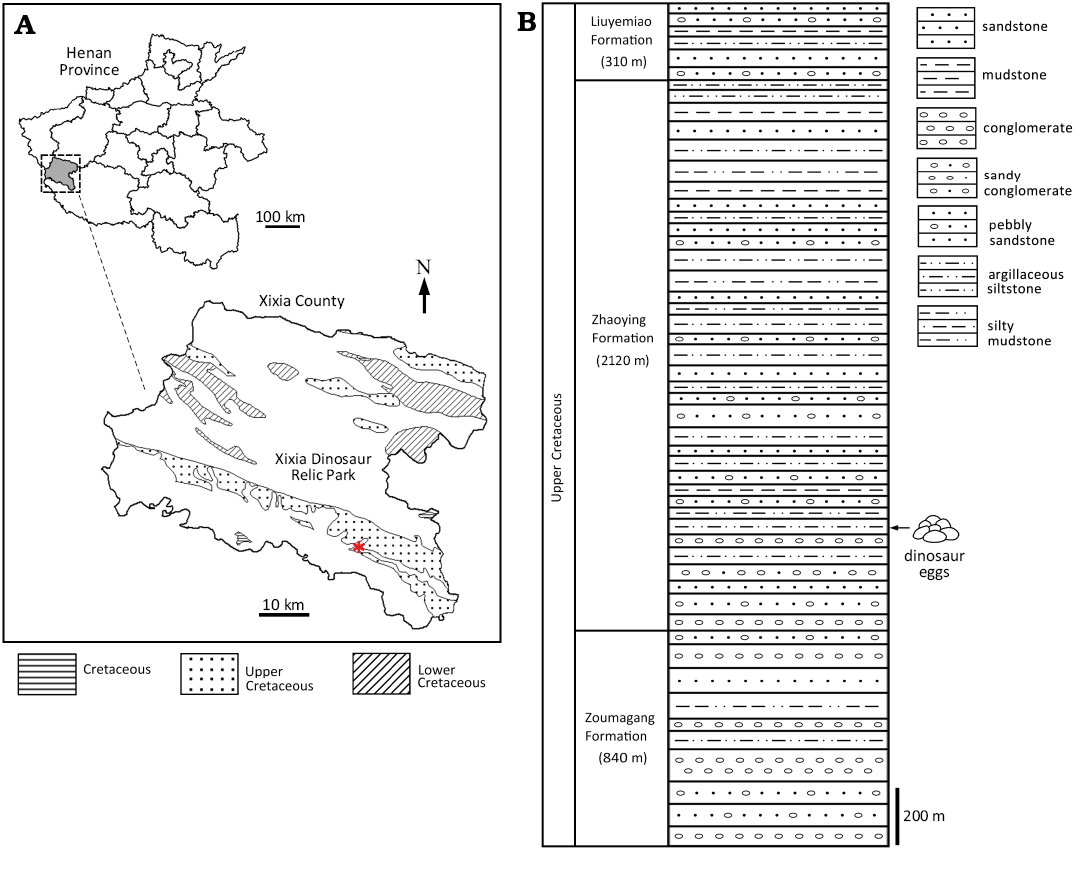
Fig. 1. A. Geographical location of the newly discovered dinosaur eggs (red asterisk) in the Upper Cretaceous rocks of Xixia County, Henan Province, China. B. Lithology of the Upper Cretaceous formations in the Xixia Basin showing the stratigraphic position of the dinosaur eggs described herein.
Institutional abbreviations.—GMC, Geological Museum of China, Beijing, China; GSW, Shaanxi Nature Museum, Xian, Shaanxi Province, China; IVPP, Institute of Vertebrate Paleontology and Paleoanthropology, Chinese Academy of Sciences, Beijing, China; SLGTJ-RJC, Bureau of Land and Resources of Shangluo, Shaanxi Province, China; TTM, Tiantai Museum, Taizhou, Zhengjiang Province, China; YJYM, Dinosaur Egg Fossil Museum of Xixia Dinosaur Relics Park, Xixia, Henan Province, China; SREE, School of Resources and Environmental Engineering, Anhui University, Hefei, Anhui Province, China.
Other abbreviations.—CL, cathodoluminescence; PLM, polarized light microscope; SEM, scanning electron microscope.
Nomenclatural acts.—This published work and the nomenclatural acts it contains have been registered in ZooBank: urn:lsid:zoobank.org:pub:714D4690-D1A6-46D7-A350-7EDEFAADCE40.
Geological settings
The Xixia Basin is a typical Mesozoic continental sedimentary basin located along the eastern side of the Qinling Orogenic Belt, which is distributed in the northwest direction with a length of approximately 100 km in the east-west direction and an area of 518 km2 (Zhou et al. 1999; Wang et al. 2008; Jia et al. 2020). A set of Upper Cretaceous fluvial sediments was deposited over the Devonian Nanwan Formation in the Xixia Basin (Jia et al. 2020). At present, there are two schemes for stratigraphic division of Upper Cretaceous in the Xixia Basin. Zhao et al. (2015) and Fang et al. (2007a) divide the Upper Cretaceous strata into Zoumagang, Zhaoying and Liuyemiao formations in an ascending order, whereas Jia et al. (2020) and Zhou et al. (2001a) consider that the succession is composed of Gaogou, Majiacun, and Sigou formations from bottom to up. Since the latter classificatory scheme was mainly established in the Xichuan basin, adjacent to Xixia Basin (Wang et al. 2012; Zhao et al. 2015), we use the former division in this paper. The Zoumagang Formation is dominated by the upper purplish gray thick-bedded conglomerates interbedded with brown-red medium thick-bedded sandstones and argillaceous siltstones with a thickness of about 840 m, and the lower purplish red fine siltstones interbedded with conglomerates with a thickness of about 211 m; the upper member of the Zoumagang Formation belongs to the Upper Cretaceous based on the lithology and fossils (Fang et al. 2007a, b; Wang et al. 2012). The Zhaoying Formation consists of the lower motley argillaceous siltstones, sandstones and mudstones and the upper reddish mudstones and sandstones with a thickness of 2120 m, while the Liuyemiao Formation is composed of the bottom pebbly sandstones, the lower gray-yellow thick sandstones interbedded with purplish red thin argillaceous siltstones and mudstones, and the upper gray-white thick sandstones with purplish red pebbly sandstone interlayers, about 310 m in thickness (Fang et al. 2007a, b). The Zoumagang and Zhaoying formations yield lots of dinosaur eggs, such as Macroelongatoolithus xixiaensis (Li et al. 1995; Zhao et al. 2015; He et al. 2020), Prismatoolithus gebiensis (Fang et al. 2007a; Zhao et al. 2015), Parafaveoloolithus xipingensis (Fang et al. 1998; Zhao et al. 2015), Pionoolithus quyuangangensis (He et al. 2019), Dendroolithus sanlimiaoensis?, D. furcatus?, and D. dendriticus? (Fang et al. 1998; Zhao et al. 2015). The newly discovered dinosaur eggs are preserved in the argillaceous siltstones from the Upper Cretaceous Zhaoying Formation in the Xixia Basin (Fig. 1B), which represents a typical fluvio-lacustrine environment with an arid climate (Fang et al. 1998). A number of invertebrate fossils (bivalves, gastropods, ostracodes, and spinicaudatans), plant fossils, ichnofossils, dinosaur bones and turtle egg fossils were also reported along with dinosaur eggs in the Zhaoying Formation (Fang et al. 2007a; Wang et al. 2008; Li et al. 2009).
Material and methods
A clutch containing 13 dinosaur eggs was discovered in the Upper Cretaceous Zhaoying Formation of Xixia Basin (Fig. 2). The single dinosaur eggs are numbered as YJYM-01–13 and housed in YJYM. Eggshell fragments from each dinosaur egg in the clutch were analyzed because the weathering process damaged the outer surface and the radial microstructures of the inner surface. Four or five eggshell fragments of each egg were collected and numbered based on the number of each egg. The loose surrounding rocks on the outer surface were eliminated using small needles. All eggshell fragments were cleaned using pure water in an ultrasonic bath for 10 minutes and then dried in a laundry dryer at the Geological Laboratory of SREE. Eggshell thicknesses were measured several times with vernier calipers and the average values were ultimately adopted. Each eggshell was embedded in Technovit 7200 one-component resin and one radial and two tangential sections per eggshell were cut by an EXAKT 300CP automatic microtome. Sections were finally ground and polished to about 35 μm and 45 μm thickness with an EXAKT 400CP variable speed grinder polisher and abrasive paper. All of the above processes were finished at IVPP. The 35 μm sections covered with coverslips and the 45 μm sections without any coverslips were then viewed and photographed with Olympus BX53 PLM and DELMIC CL, respectively, for the identification of microstructure and assess diagenesis. Some eggshell fragments were fractured to expose fresh sections without etching and were subsequently observed using a SEM (FlexSEM 1000Ⅱ) at Anhui University to image the three-dimensional microstructure. Fragments were mounted on aluminum stubs with carbon tape and a heated tungsten filament was used to generate and accelerate electrons at a beam current of 100 μA, a voltage of 20 kV, and a working distance of 5 mm. SEM images were acquired in backscattered electron (BSE) mode. Radial and tangential sections with complete microstructures were labeled as X13-01–05 and selected for systematic paleontological description and comparison at SREE. The pore density is defined by the number of pores per square mm and was obtained by manually counting the number of pores in tangential sections.
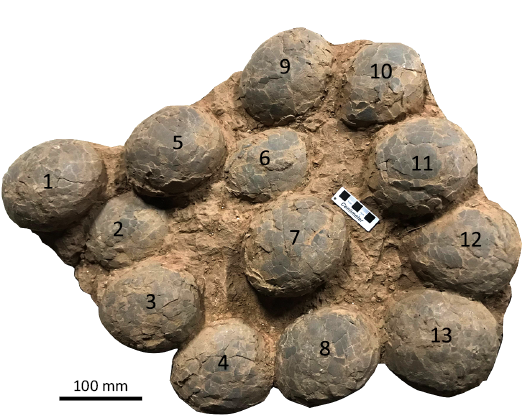
Fig. 2. A clutch of dinosaur egg oospecies Parafaveoloolithus xixiaensis oosp. nov. YJYM-01–13 (each egg has unique repository number), from the Upper Cretaceous of the Xixia Basin, Henan Province, China.
Systematic palaeontology
The newly discovered dinosaur eggs from Xixia County, Henan Province, China belong to Parafaveoloolithus in Faveoloolithidae, which contains many oospecies: Parafaveoloolithus xipingensis, P. fengguangcunensis, P. macroporus, P. microporus, P. tiansicunensis, P. pingxiangensis, and P. guoqingsiensis (Fang et al. 1998, 2005; Zhang 2010; Zou et al. 2013; Zhao et al. 2015). During our research, we found that P. guoqingsiensis is more closely related to the oogenus Propagoolithus, while the characteristics of the oogenus Duovallumoolithus in Faveoloolithidae are highly similar to those of Parafaveoloolithus. In order to facilitate the comparison of our new materials with other members of Parafaveoloolithus, we first revised the oogenus Parafaveoloolithus and then described our new materials from Xixia County, Henan Province, China.
Oofamily Faveoloolithidae Zhao & Ding, 1976
Oogenus Propagoolithus Kim et al., 2019
Type oospecies: Propagoolithus widoensis Kim et al., 2019; Upper Cretaceous Siltstones within the Daeri Andesite of the Wido Volcanics of the northeastern Wi Island, Buan County, North Jeolla Province, South Korea.
Emended diagnosis.—Slightly nodulose or smooth surface. Eggshell units are branching out, while pore canals accordingly gradually become smaller in diameter towards the outer eggshell.
Propagoolithus guoqingsiensis (Fang et al., 2000) comb. nov.
2000 Dendroolithus guoqingsiensis; Fang et al. 2000: 109, figs. 21, 22.
2011 Parafaveoloolithus guoqingsiensis; Wang et al., 2011: 447, fig. 1G, H, I.
2015 Parafaveoloolithus guoqingsiensis; Zhao et al. 2015: 118, figs. 78, 79.
Type material: Holotype: GMC Zhe-9-3, a complete egg (Fang et al. 2000). Paratypes: TTM 12, an incomplete clutch composed of ten eggs; IVPP V16511, an incomplete egg (Zhao et al. 2015).
Type locality: Muyushan district, Tiantai County, Zhejiang Province, China.
Type horizon: The Chichengshan Formation, Upper Cretaceous;
Emended diagnosis.—Propagoolithus guoqingsiensis is characterized by spherical eggs with 187 mm in length and 177 mm in width. The shape index (width×100/length) is 94.7 and eggshell thickness is 1.30–1.50 mm. The eggshell units are composed of a single layer, divided into two or three branches in the middle part of the eggshell and combined with neighboring shell units near the outer surface of the eggshell. In the tangential sections through the middle part of the eggshell, the diameter of pores is 0.02–0.21 mm with sharp edges and the pore density is 55–60 per mm2.
Remarks.—Slender eggshell units of Propagoolithus guoqingsiensis branch out in the middle part of the eggshell and pore canals accordingly gradually become smaller towards the outer surface of the eggshell in the radial thin section (Fang et al. 2000; Wang et al. 2011), which differ from the relatively uniform width of eggshell units and pores in Parafaveoloolithus (Zhang 2010; Zhao et al. 2015) and conform to the characteristics of Propagoolithus (Kim et al. 2019). Relatively large and irregular pores of P. guoqingsiensis are observable in the tangential section near the inner surface of the eggshell; irregular to sub-circular pores are developed in the middle part of the eggshell while smaller pores are observed near the outer surface of the eggshell (Fang et al. 2000; Wang et al. 2011; Zhao et al. 2015). The morphological change of pores from the inner to outer surface of P. guoqingsiensis is similar to that of Propagoolithus (Kim et al. 2019; Jo et al. 2023). The slightly nodulose or smooth outer surfaces are present on both P. guoqingsiensis and Propagoolithus (Zhao et al. 2015; Kim et al. 2019). Therefore, P. guoqingsiensis from the Chichengshan Formation is more similar to oospecies of Propagoolithus than to Parafaveoloolithus and is thus reassigned to Propagoolithus.
The only known oospecies of Propagoolithus is Propagoolithus widoensis, which is characterized by a slightly nodulose surface and slender eggshell units that become wider towards the outer surface (Kim et al. 2019). Branched and irregular shaped eggshell units both exist in Propagoolithus widoensis and P. guoqingsiensis (Zhao et al. 2015; Choi et al. 2021; Kim et al. 2022). However, the thickness of P. guoqingsiensis (1.30 mm in GMC Zhe-9-3, 1.40–1.50 mm in TTM 12, average: 1.40 mm) (Fang et al. 2000; Wang et al. 2011) is smaller than that of Propagoolithus widoensis (1.34–1.98 mm, average: 1.62 mm) (Kim et al. 2019). Propagoolithus guoqingsiensis is characterized by its large egg size within Faveoloolithidae (Zhao et al. 2015). Although the exact size of P. widoensis is uncertain due to lithostatic compression and its resulting flattened geometry, its maximum length (~150 mm) is still smaller than the average length of P. guoqingsiensis (187 mm) (Zhao et al. 2015; Kim et al. 2019: fig. 3B), indicating that P. guoqingsiensis is distinctly larger. Therefore, Parafaveoloolithus guoqingsiensis represents another oospecies of Propagoolithus and could be renamed as Propagoolithus guoqingsiensis (Fang et al., 2000) comb. nov.
Stratigraphic and geographic range.—Upper Cretaceous, Zhejiang Province, China.
Oogenus Parafaveoloolithus Zhang, 2010
2018 Duovallumoolithus Zheng et al., 2018: 899, figs. 3, 4, 5.
Type oospecies: Parafaveoloolithus microporus Zhang, 2010; Upper Cretaceous Laijia Formation, Tiantai County, Zhejiang Province, China.
Emended diagnosis.—Eggs are spherical or subspherical in shape with a smooth surface. Eggshell is usually composed of a single layer of eggshell units with 2–5 secondary eggshell units in some portions. Eggshell units are columnar in shape and loosely arranged, which separate from each other near the inner surface of eggshell, but gather in groups occasionally in the middle or upper part of eggshell. Boundaries between columnar eggshell units are relatively clear and nearly straight pore canals are observed. Two adjacent pores are separated by two eggshell units and interspaces are widely observed in tangential sections.
Stratigraphic and geographic range.—Upper Cretaceous, Zhejiang Province, China.
Parafaveoloolithus shangdanensis (Zheng et al., 2018) comb. nov.
2018 Duovallumoolithus shangdanensis; Zheng et al. 2018: 899, figs. 3, 4, 5.
Type material: Holotype: four single dinosaur eggs (GSW-087-2–5). Paratypes: two clutches containing seven eggs (SLGTJ-RJC-1, SLGTJ-RJC-2); other specimens: several eggshell fragments.
Type locality: Renjiacun, Yangyuhe Town, Shangluo City, Shaanxi Province, China.
Type horizon: The Lijiacun Formation, Upper Cretaceous.
Emended diagnosis.—Eggs are subspheroidal and smooth on the outer surface. The length ranges 165–192 mm (average 181 mm) and the width ranges 143–168 mm (average 154 mm) with an average shape index of 85.08. Eggshell thickness is relatively large, with an average value of 1.80 mm. Eggshell units consist of a single layer and are columnar in shape, with nearly straight pore canals. The diameter of the pore canals remains constant from the inner surface to the outer eggshell. The pores in the middle part of the eggshell are irregular with a diameter of 0.08–0.36 mm and the pore density is about 13 per mm2.
Remarks.—The oogenus “Duovallumoolithus” was erected mainly based on the developed interspaces between two eggshell units and the relatively closely arranged eggshell units (Zheng et al. 2018). However, the characteristic that two adjacent pores are separated by two eggshell units and interspaces are widely observed, and is consistent with the known oospecies of Parafaveoloolithus (Fig. 3), even including the new materials described herein. For example, interspaces between two eggshell units are obvious in the tangential section through the middle part of P. macroporus (Fig. 3A) (Zhao et al. 2015: 115, fig. 74D). Furthermore, because massive pores are present in the radial and tangential sections of “Duovallumoolithus” with the pore diameters varying between 0.12 and 0.44 mm (Zheng et al. 2018), the other characteristic that the eggshell units are closely arranged in “Duovallumoolithus” is an inaccurate representation. Although the pore canals between eggshell units are filled with secondary minerals with dark colors, nearly straight pore canals are observed in the thin section of eggshell (Zheng et al. 2018: 902, fig. 5A). Therefore, we regarded that these two characters cannot be used in the diagnosis of oogenus and “Duovallumoolithus” is an invalid oogenus because the diagnostic elements of “Duovallumoolithus” also exist in Parafaveoloolithus. “Duovallumoolithus shangdanensis” should be reassigned to the Parafaveoloolithus based on the following two aspects, which are not present in Faveoloolithus and Hemifaveoloolithus: (i) two adjacent pores are separated by two eggshell units and interspaces are widely observed in Parafaveoloolithus; (ii) nearly straight pore canals are also observed in both oogenera. However, the length and width of these specimens vary between 165–192 mm and 143–168 mm, respectively, which are larger than those of other oospecies of Parafaveoloolithus (130–170 mm and 100–143 mm). Similarly, the width of the eggshell unit in these eggs is 0.12–0.23 mm, larger than that of other oospecies of Parafaveoloolithus (about 0.03–0.17 mm). The dinosaur eggs from Shangluo City, Shaanxi Province, are assigned to an independent oospecies of Parafaveoloolithus named Parafaveoloolithus shangdanensis comb. nov.
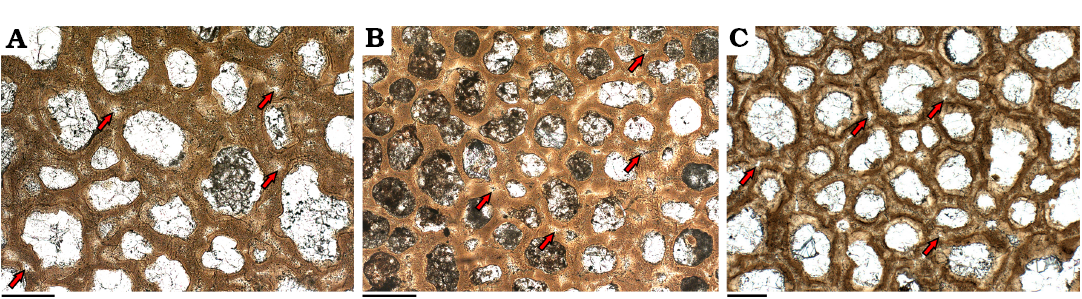
Fig. 3. Interspaces between two eggshell units in the known oospecies of Parafaveoloolithus. A. Parafaveoloolithus macroporus Zhang, 2010 (IVPP V 16858) from Upper Cretaceous Laijia Formation, Tiantai County, Zhejiang Province, China. B. Parafaveoloolithus microporus Zhang, 2010 (IVPP V 16857.1) from Upper Cretaceous Laijia Formation, Tiantai County, Zhejiang Province, China. C. Parafaveoloolithus tiansicunensis Zhang, 2010 (IVPP V 16859) from Upper Cretaceous Chichengshan Formation, Tiantai County, Zhejiang Province, China. Arrows point to interspaces. Scale bars 200 µm.
Stratigraphic and geographic range.—Upper Cretaceous, Shaanxi Province, China.
Parafaveoloolithus xixiaensis oosp. nov.
Figs. 2, 4–6.
Zoobank LSID: urn:lsid:zoobank.org:act:83E8FB93-E433-46DB-A6 FD-13E20060395F.
Etymology: From Chinese phonetic Xixia, the locality where dinosaur eggs were found.
Holotype: A clutch composed of 13 dinosaur eggs (YJYM-01–13) are housed in YJYM; five thin sections of eggshell (X13-01–05) are housed in SREE.
Type locality: Sanlimiao District, Danshui Town, Xixia County, Henan Province, China.
Type horizon: The Zhaoying Formation, Upper Cretaceous.
Diagnosis.—Eggs show a subspherical shape, which are evenly distributed and indicate a radial arrangement in the clutch. These eggs are small in size and the lengths and widths are 123.3–142.6 mm and 97.2–127.2 mm, respectively. The shape index is 84 and eggshell thickness is 1.42–1.76 mm. Radial sections of eggshell comprise a single structural layer composed of slender eggshell units with a width of 0.05–0.11 mm and straight pore canals with a large width of 0.10–0.23 mm. Some secondary eggshell units are assembled in the radial sections and growth lines are undeveloped. Tangential sections consist of irregular eggshell units and subcircular pores with a pore diameter of 0.11–0.30 mm in the middle part, showing honeycomb-like structures.
Description.—The egg clutch is subcircular in shape, approximately 62 cm in length and 53 cm in width. It is composed of 13 eggs (YJYM-01–13) with a radial arrangement in the clutch (Fig. 2). Most eggs are outcropped completely and three of them are partly emerged (YJYM-02, 06, 10), but all of them are well-preserved. YJYM-05 is directly superimposed on YJYM-02 and YJYM-06, indicating that this is likely to be a result of an original planar clutch affected by displacement prior to or after compaction (Wilson et al. 2014). Eggs are subspherical with no prominent ornamentation on the outer surface. The length of these eggs ranges between 123.3 mm and 142.6 mm (average: 132.4 mm) while the width ranges between 97.2 mm and 127.2 mm (average 111.3 mm). Egg shape index varies between 76 and 89 with an average of 84 (Table 1).
Table 1. Measurments (in mm) of Parafaveoloolithus xixiaensis oosp. nov. in the Xixia Basin, Henan Province, China. “–”the absence of relevant data; ”+” a value higher than this data (the actual length and width of YJYM-02, 06, 10 are larger than the measured data due to partially bury).
|
Egg number |
Length |
Width |
Shape index |
|
YJYM-01 |
129.3 |
104.2 |
81 |
|
YJYM-02 |
102.5+ |
85.0+ |
– |
|
YJYM-03 |
123.3 |
108.3 |
88 |
|
YJYM-04 |
128.6 |
111.7 |
87 |
|
YJYM-05 |
126.0 |
101.6 |
81 |
|
YJYM-06 |
105.5+ |
79.5+ |
– |
|
YJYM-07 |
137.8 |
117.3 |
85 |
|
YJYM-08 |
137.8 |
112.2 |
81 |
|
YJYM-09 |
127.6 |
97.2 |
76 |
|
YJYM-10 |
121.4+ |
91.9+ |
– |
|
YJYM-11 |
137.5 |
118.9 |
86 |
|
YJYM-12 |
133.6 |
114.8 |
86 |
|
YJYM-13 |
142.6 |
127.2 |
89 |
|
Average |
132.4 |
111.3 |
84 |
Eggshells contain a single structural layer in the radial section, composed of loosely arranged eggshell units and more or less straight pore canals, which are clearly shown under PLM with cross-polarized light, CL and SEM (Fig. 4). Eggshell units are slender while pore canals are thicker (Fig. 4A1). In the CL image of the radial section, non-luminescent and orange-yellow luminescent domains each occupy approximately half of the area, reflecting two distinct stages of calcite mineralization. The primary eggshell units are mostly non-luminescent, supporting that the original microstructure remains well-preserved and minimally altered by diagenesis. In contrast, the sparry calcites infilling the pores display orange-yellow luminescence, reflecting their secondary origin. The non-luminescent and orange-yellow luminescence domains are parallel in the CL image (Fig. 4A2). The ultrastructural features including a single layer and nearly straight pore canals are more distinct under SEM (Fig. 4A3). Eggshell units are composed of homogeneous calcite crystals without growth lines. A large number of pore canals from the inner to outer surface indicate the developed pore system of faveoloolithid eggs. Each pore canal is surrounded by 4–5 eggshell units. A few radial microstructures composed of calcite microcrystals could be seen in the inner portion of the eggshell (Fig. 4A3, A4). Some secondary eggshell units are observed in the radial section of the eggshell and their radial microstructures are obvious under PLM with plain-polarized light (Fig. 5A1, A2). Most of the eggshell units are columnar and slender, with the width ranging between 0.05 and 0.11 mm (average: 0.08 mm). Upright pore canals are well-developed, distributed among the parallel eggshell units and filled with secondary calcite. The diameters of pore canals vary between 0.10 mm and 0.23 mm, with an average of 0.17 mm. The porosity of the eggshell reaches up to about 50% showing the multicanaliculate pore system. The radial microstructures of columnar eggshell units near the inner surface are not obvious due to weathering. Slender eggshell units gather with neighboring shell units and become slightly wider in the middle part of the eggshell. Six secondary eggshell units gather in the middle part of the eggshell, forming an extra layer in the eggshell of YJYM-13 (Fig. 5A3). The growth centers of these secondary eggshell units are obvious (Fig. 5A4). Compared with the inner surface, the diameter of pore canals of the middle and outer surface is slightly smaller. A crystalline layer composed of secondary calcite could be seen near the outer surface of the eggshell.
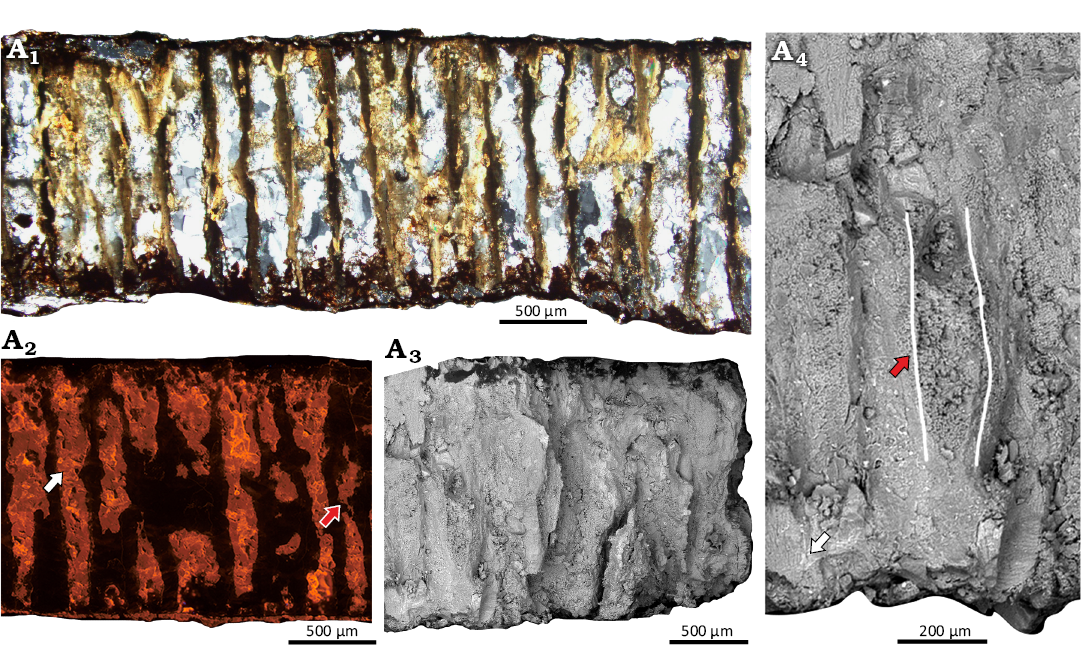
Fig. 4. Radial sections (SREE X13-01) of dinosaur eggshell Parafaveoloolithus xixiaensis oosp. nov. (YJYM-13) from the Upper Cretaceous of the Xixia Basin, Henan Province, China. A1. Cross-polarized light image showing a single structural layer. A2. CL image showing different colors of eggshell units and pore canals. A red arrow points to eggshell units with black colors, while a white arrow points to the pore canals with orange-yellow colors. A3, A4. BSE images showing the ultrastructural features composed of a single layer and nearly straight pore canals. A red arrow points to a pore canal while a white arrow points to the radial microstructure in the inner portion of the eggshell.
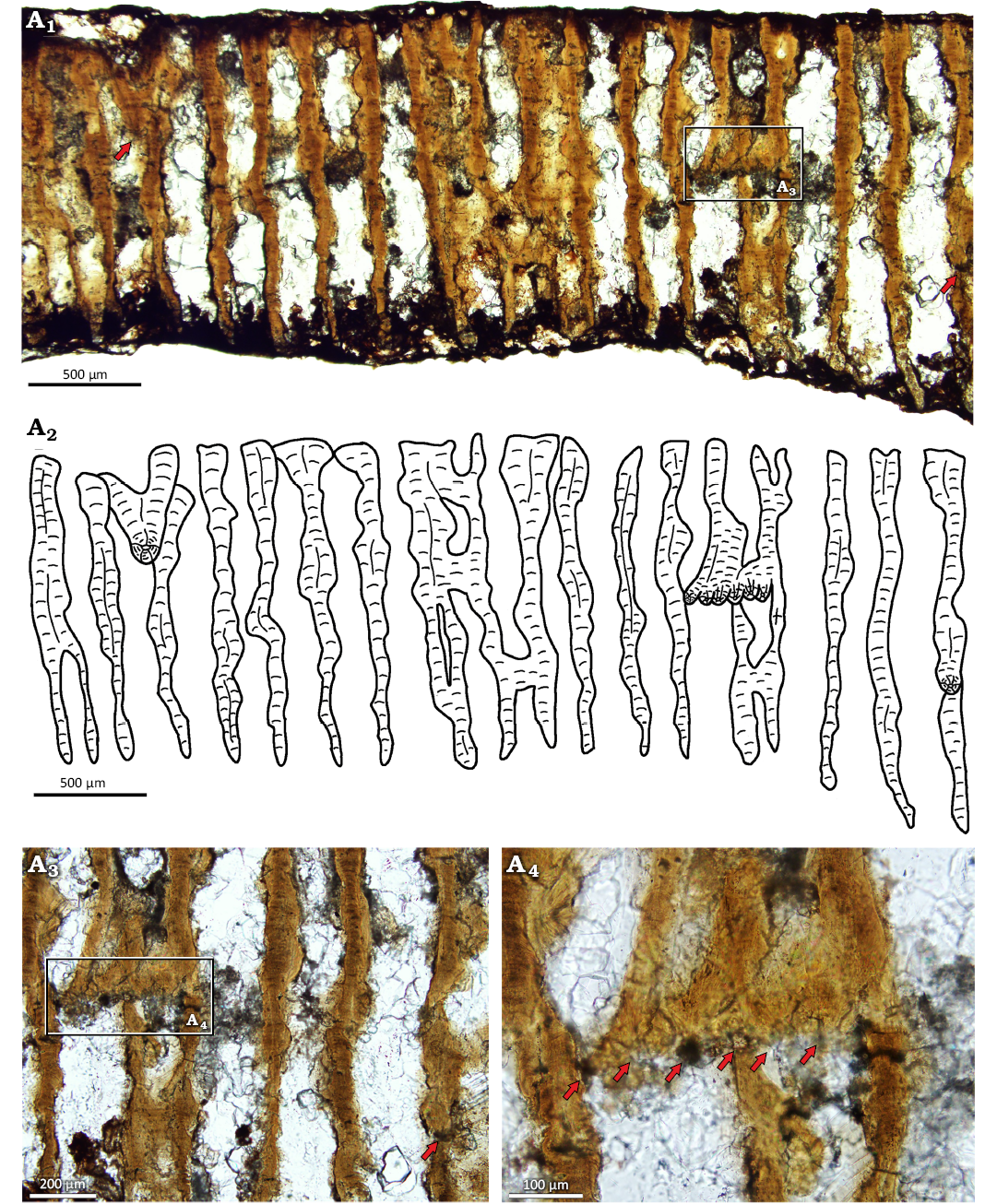
Fig. 5. Thin sections (SREE X13-01) of dinosaur eggshell Parafaveoloolithus xixiaensis oosp. nov. (YJYM-13) from the Upper Cretaceous of the Xixia Basin, Henan Province, China. A1. A single structural layer composed of loosely arranged eggshell units and the straight pore canals between eggshell units; arrows indicate the secondary eggshell units. A2. A line drawing showing the eggshell units in radial section. A3. Enlargement of the gathered eggshell units; arrow points to the single eggshell unit. A4. Growth centers of the gathered eggshell units; arrows point to the six growth centers.
Eggshells in the tangential sections exhibit honeycomb-like structures under PLM with plain-polarized light. Round or sub-round pores filled with white secondary calcites are observed among complicatedly interconnected eggshell units (Fig. 6). The diameter and morphology of pores vary in different tangential sections. Most pores are irregular to subcircular in the tangential section through the inner part of the eggshell; the diameter of pores ranges from 0.15 to 0.41 mm, with an average of 0.28 mm, and the pore density is 16–20 per mm2 (18 per mm2 in average) (Fig. 6A1). Pores are subcircular or circular in the middle part of the eggshell and become smaller varying between 0.11 mm and 0.30 mm, with an average of 0.21 mm; the pore density become larger with 21–25 per mm2 (23 per mm2 in average) (Fig. 6A2). The interspaces between eggshell units are distinct in the middle part of the eggshell (Fig. 6A3). Compared with the middle part of the eggshells, most of the pores are rounder and smaller near the outer surface. The diameter of pores varies between 0.05 mm and 0.27 mm (0.16 mm in average) with a pore density of 29–35 per mm2 (32 per mm2 in average) (Fig. 6A4).
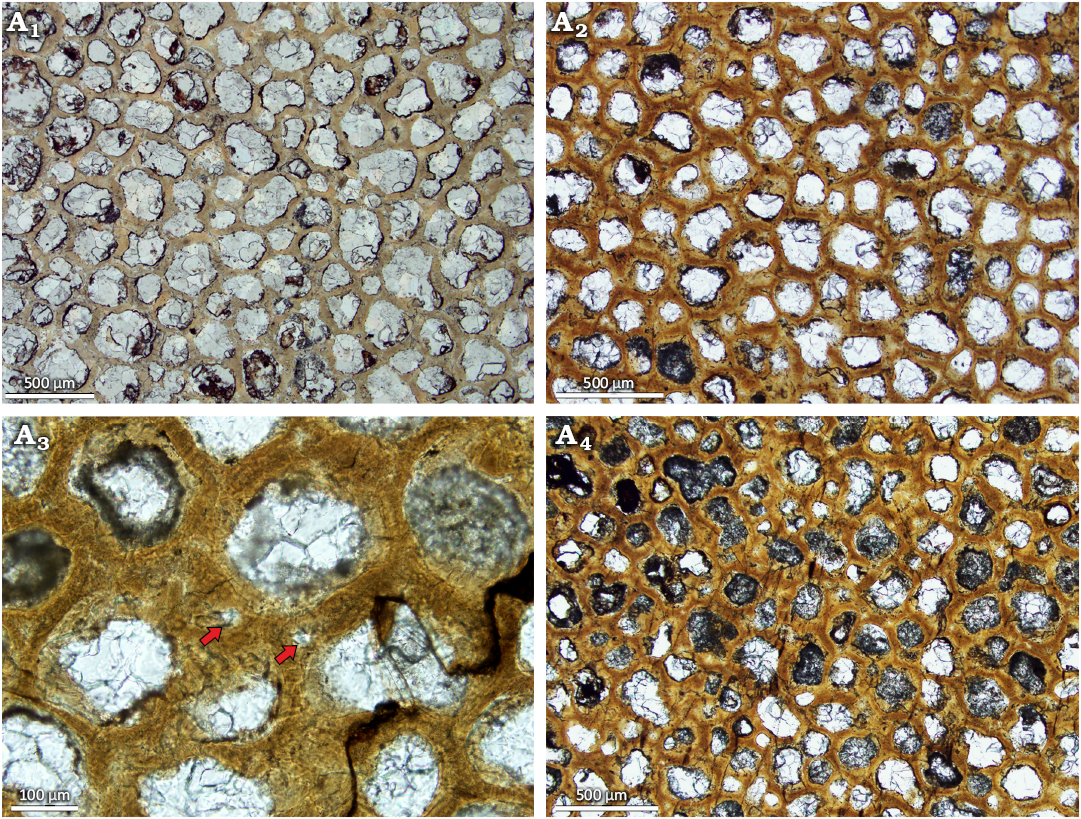
Fig. 6. Tangential sections of dinosaur eggshell Parafaveoloolithus xixiaensis oosp. nov. (YJYM-13) from the Upper Cretaceous of the Xixia Basin, Henan Province, China. A1. Section SREE X13-02, the inner surface of the eggshell, showing the irregular and large pores. A2. Section SREE X13-03, the middle part of the eggshell, showing the circular and subcircular pores. A3. Interspaces between two adjacent eggshell units in the middle part of the eggshell; arrows point to interspaces. A4. Section SREE X13-03, the outer surface of the eggshell, showing circular and smaller pores. Images under PLM with plain-polarized light.
Remarks.—The slender and columnar eggshell units in radial sections and honeycomb-like microstructures in tangential sections of these dinosaur eggs from Xixia Dinosaur Relics Park align with the diagnostic characteristics of Faveoloolithidae (Zhao and Ding 1976). Since Duovallumoolithus shangdanensis was revised to Parafaveoloolithus, five oogenera belong to Faveoloolithidae: Faveoloolithus (Zhao and Ding 1976), Hemifaveoloolithus (Wang et al. 2011), Parafaveoloolithus (Zhang 2010), Propagoolithus (Kim et al. 2019), and Hormoolithus (Wang et al. 2022). Because the oofamily “Youngoolithidae” was considered to be invalid and the only oogenus Youngoolithus was reassigned to Faveoloolithidae (Kim et al. 2019), we also compare the characteristics of Youngoolithus with our samples (Table 2). The subspherical shape and smaller length of dinosaur eggs described here are distinctly different from that of the ellipsoidal shape and greater length of Youngoolithus; the number of secondary eggshell units in the former is less than that of Youngoolithus (Zhao 1979; Zhang 2010). Among the known oogenera of Faveoloolithidae, the pore density in the middle part of the tangential thin section (40–50 per mm2) in Hemifaveoloolithus (Wang et al. 2011) is greater than that of dinosaur eggs from Xixia Dinosaur Relics Park (21–25 per mm2). Unlike the branched eggshell units merging towards the outer surface of Propagoolithus (Kim et al. 2019), there are no significant changes in the parallel eggshell units near the outer surface of the currently described dinosaur eggs. The macrostructures of these dinosaur eggs present similar characteristics with Faveoloolithus, such as length, width and eggshell thickness, but the slender eggshell units and unapparent horizontal lines on the eggshell units differ from the wide eggshell units and the developed horizontal lines of Faveoloolithus (Zhao and Ding 1976; Zhang 2010; Zhao et al. 2015). Furthermore, Hormoolithus is described as an oogenus with a large number of secondary eggshell units developed around the eggshell units and the presence of a proliferative layer in the pores in the middle part of the eggshell, which are not apparent in our samples (Wang et al. 2022). These dinosaur eggs from Xixia Dinosaur Relics Park are assigned to Parafaveoloolithus based on the subspherical shape, columnar eggshell units, absence of horizontal lines on the eggshell units, and partially developed secondary eggshell units in the radial sections.
Table 2. Measurements (in mm) and characteristics of different oogenera (including the doubtful oogenus Youngoolithus) in Faveoloolithidae. Diameter of eggshell units in the middle part of the eggshell; pore density in the middle part of eggshell (per mm2); “–” the absence of relevant data.
|
Oogenus |
Length |
Width |
Shape index |
Thickness |
Diameter |
Pore density |
References |
|
Faveoloolithus |
130.8–143.7 |
117.6–127.9 |
92.7 |
1.20–1.54 |
0.07–0.40 |
18 |
|
|
Hemifaveoloolithus |
130, 137 |
120, 121 |
90.3 |
1.60 |
– |
40–50 |
|
|
Parafaveoloolithus |
130–192 |
100–168 |
74.0–96.0 |
1.37–2.35 |
0.04–0.64 |
12–55 |
|
|
Propagoolithus |
187, 150 |
177 |
94.7 |
1.30–1.98 |
0.02–0.21 |
55–60 |
|
|
Hormoolithus |
– |
– |
– |
1.65–1.71 |
0.10–0.35 |
– |
|
|
Youngoolithus |
156.0–173.4 |
91.0–109.4 |
59.8 |
1.45–1.60 |
0.07–0.33 |
26 |
After the revisions of Duovallumoolithus shangdanensis and Parafaveoloolithus guoqingsiensis, Parafaveoloolithus is currently composed of P. xipingensis, P. fengguangcunensis, P. macroporus, P. microporus, P. tiansicunensis, P. pingxiangensis, and P. shangdanensis comb. nov. (Fang et al. 1998, 2005; Zhang 2010; Wang et al. 2011; Zhao et al. 2015; Zheng et al. 2018). We compared the Parafaveoloolithus eggs from Xixia Dinosaur Relics Park with these oospecies of Parafaveoloolithus (Table 3, Fig. 7).
As shown in Table 3 and Fig. 7A, B, egg length and width of Parafaveoloolithus from Xixia Dinosaur Relics Park (123.3–142.6 mm, 97.2–127.2 mm) are less than those of P. xipingensis (170 mm, 143 mm) (Fang et al. 1998; Zhao et al. 2015), P. fengguangcunensis (150–170 mm) (Fang et al. 2005; Zhao et al. 2015) and P. shangdanensis comb. nov. (165–192 mm, 143–168 mm) (Zheng et al. 2018). Meanwhile, eggshell unit and pore canal widths of Parafaveoloolithus from Xixia Dinosaur Relics Park (0.05–0.11 mm, 0.10–0.23 mm) are larger than those of P. pingxiangensis (0.03–0.06 mm, 0.02–0.05 mm) (Zou et al. 2013) based on Fig. 7C, D. The above four oospecies could be excluded, and we further compare Xixia eggs with P. microporus, P. macroporus, and P. tiansicunensis, which have similar egg sizes, eggshell unit widths and pore canal widths.
Table 3. Measurements (in mm) and characteristics of different oospecies in Parafaveoloolithus. The width of eggshell units and pore canals in the radial sections. The pore diameter in the middle part of the tangential sections. The pore density in the middle part of eggshell units from the tangential sections (per mm2). “–” represents the absence of relevant data.
|
Oospecies |
Length |
Width |
Height |
Shape index |
Thickness |
Width |
Pore |
References |
||
|
eggshell units |
pore |
diameter |
density |
|||||||
|
Parafaveoloolithus xipingensis |
170 |
143 |
– |
84.1 |
1.70–2.00 |
– |
– |
– |
– |
|
|
Parafaveoloolithus fengguangcunensis |
150–170 |
– |
– |
– |
1.60 |
– |
– |
– |
– |
|
|
Parafaveoloolithus macroporus (2 eggs) |
130 135 |
100 100 |
– |
74 76 |
1.85–1.90 |
0.11–0.17 |
0.13–0.18 |
0.04–0.64 |
12 |
|
|
Parafaveoloolithus microporus |
141.06 |
129.44 |
– |
91.8 |
2.20–2.35 |
0.04–0.08 |
0.07–0.15 |
0.06–0.25 |
35 |
|
|
Parafaveoloolithus tiansicunensis |
– |
– |
– |
– |
1.37–1.45 |
0.09–0.16 |
0.06–0.13 |
0.10–0.42 |
17 |
|
|
Parafaveoloolithus pingxiangensis |
– |
138.1 |
73.2 |
– |
1.40–1.60 |
0.03–0.06 |
0.02–0.05 |
0.06–0.21 |
40–55 |
|
|
Parafaveoloolithus shangdanensis |
165–192 |
143–168 |
– |
74.5–96.0 |
1.80 |
0.12–0.23 |
0.09–0.17 |
0.08–0.36 |
13 |
|
|
Parafaveoloolithus xixiaensis oosp. nov. |
123.3–142.6 |
97.2–127.2 |
– |
76.0–89.0 |
1.42–1.76 |
0.05–0.11 |
0.10–0.23 |
0.11–0.30 |
21–25 |
this paper |
The eggshell thickness of Xixia eggs is 1.42–1.76 mm, less than that of P. microporus (2.20–2.35 mm), while the pore density in the middle part (21–25 per mm2) is similarly less than that of P. microporus (35 per mm2) (Zhang 2010).
The maximum pore diameter in the middle part of P. macroporus can reach 0.64 mm, which is much larger than that of Parafaveoloolithus eggs in Xixia Dinosaur Relics Park (0.30 mm). Meanwhile, the eggshell units in the middle part of radial sections of P. macroporus separate from each other in contrast to the partly merged eggshell units of our dinosaur eggs with gathered secondary eggshell units; the pore density (12 per mm2) of the former is less than that of the latter (21–25 per mm2) in the middle part of the eggshell (Zhang 2010; Zhao et al. 2015).
The specimens described here are similar to P. tiansicunensis in the eggshell thickness, the pore diameter and pore density in the middle part of the eggshell, but there are several discrepancies in their microstructure in the inner and outer surfaces of the eggshell. Compared to the straight eggshell units and pore canals in our specimens, the pore canals of P. tiansicunensis widen near the inner surface and narrow sharply near the outer surface, and P. tiansicunensis generally contains one layer of columnar eggshell units but there are 2–3 relatively shorter eggshell units superimposed on each other in some portions (Zhang 2010).
According to the above comparisons, we have erected a new oospecies Parafaveoloolithus xixiaensis based on their small length-width values, slender eggshell units, straight and wide pore canals (Table 3, Fig. 7), as well as secondary eggshell units in the radial sections (Fig. 5).
Stratigraphic and geographic range.—Upper Cretaceous, Henan Province, China.
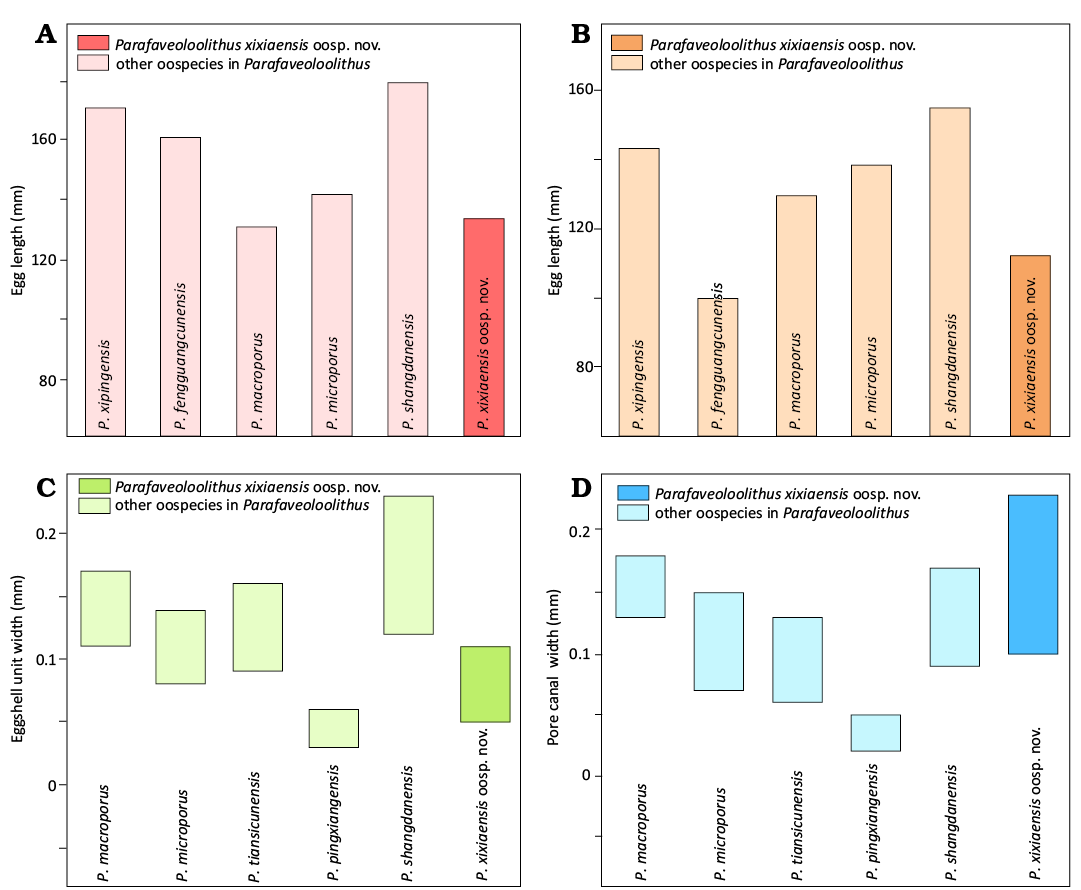
Fig. 7. The main difference between Parafaveoloolithus xixiaensis oosp. nov. and the other oospecies in Parafaveoloolithus. A. Egg length, P. xixiaensis show smaller lengths compared to the other oospecies. B. Egg width, P. xixiaensis show relatively smaller widths than the other oospecies. C. Eggshell unit width, P. xixiaensis show slender eggshell units with smaller widths in radial sections. D. Pore canal width, P. xixiaensis show wide pore canals with larger widths in radial sections.
Discussion
Taxonomic review and geographic distribution of Faveoloolithidae.—Due to the complex three-dimensional microstructure and the lack of comparison of prior research in faveoloolithid eggs, there are some problematic taxonomies in Faveoloolithidae. Numerous parataxonomic revisions on Faveoloolithidae have yielded confusion and there is a critical need to systematically summarize all of them to help researchers understand the current taxonomic status. Taxonomic review of Faveoloolithidae provides a reliable basis for the discovery and the naming of new oospecies.
Faveoloolithidae was first discovered in the northern Gobi regions (Ologoy-Ulan-Tsav), Mongolia and was named as multicanaliculate type (Sochava 1969; Zhang 2010). The oofamily Faveoloolithidae and the type oogenus Faveoloolithus and oospecies Faveoloolithus ningxiaensis were officially erected on the basis of characteristic honeycomb-like pore canals in the dinosaur eggs from Alxa, Inner Mongolia (Zhao and Ding 1976). A clutch of dinosaur eggs was discovered in a succession and characterized by olive eggs with branched eggshell units from Xiaguan Basin, Henan Province. Their microstructure is similar to that of Faveoloolithus but has branched pore canals. Zhao (1979) suggested that these dinosaur eggs from Xiaguan Basin, Henan Province represent a new oogenus Youngoolithus (Youngoolithus xiaguanensis) of Faveoloolithidae. Zhang (2010) later revised Youngoolithus into the oofamily Youngoolithidae, based on its olive-shaped egg morphology. However, Kim et al. (2019) regarded the single character (the olive egg shape) could not be used in parataxonomy and reassigned these dinosaur eggs from Xiaguan Basin, Henan Province to Faveoloolithidae. In this study, the oogenus “Duovallumoolithus” is transferred to Parafaveoloolithus based on its invalid eggshell characteristics, and the oospecies “Duovallumoolithus shangdanensis” is reclassified as Parafaveoloolithus shangdanensis comb. nov. Therefore, there are currently six oogenera (Faveoloolithus, Hemifaveoloolithus, Parafaveoloolithus, Propagoolithus, Hormoolithus, and Youngoolithus) in the Faveoloolithidae worldwide (Zhao and Ding 1976; Zhao 1979; Zhang 2010; Wang et al. 2011, 2022; Zheng et al. 2018; Kim et al. 2019; Jo et al. 2023). Faveoloolithus eggs are widely distributed in Inner Mongolia, Henan, and Hubei provinces of China (Zhao and Ding 1976; Zhou and Han 1993; Zhang and Li 1998; Zhou et al. 1998; Zhou and Feng 2002), Ologoy-Ulan-Tsav, Khulsan and Ikh-Shunkht localities, South and East Gobi provinces, Mongolia (Mikhailov 1994), and Bosung County, Chullanam-do Province of South Korea (Huh and Zelenitsky 2002). Except for Faveoloolithus ningxiaensis, most oospecies of Faveoloolithus from Henan Province, China and Chullanam-do Province, South Korea were named as F. oosp. (Zhao et al. 2015).
Hemifaveoloolithus is an oogenus with the only oospecies Hemifaveoloolithus muyushanensis in reference to the lower part of the eggshell with the honeycomb-like character, reported from Tiantai County, Zhejiang Province, China (Wang et al. 2011). Propagoolithus is an oogenus with a unique shell unit morphology in which the eggshell units branch towards the outer surface, as reported from Buan County, North Jeolla Province and Sinan (Shinan)-gun, Jeollanam-do, South Korea (Kim et al. 2019; Jo et al. 2023). Since Parafaveoloolithus guoqingsiensis was renamed as Propagoolithus guoqingsiensis in this paper, the palaeogeographical distribution of Propagoolithus extends to Tiantai County, Zhejiang Province, China. Hormoolithus is different from other faveoloolithid eggs for its accretionary layer in the pores, which consists of secondary eggshell units around eggshell units in the middle part of the tangential section; Hormoolithus dongjiangensis represents the only oospecies of Hormoolithus reported from Heyuan City, Guangdong Province, China (Wang et al. 2022). Although some titanosaur eggs were reported from the Cretaceous of Sanagasta, Entre Ríos, Río Negro 1, Yaminué and La Pampa, Argentina (Grellet-Tinner and Fiorelli 2010; Grellet-Tinner et al. 2012), it is doubtful whether their parataxonomic classifications are in line with those of faveoloolithid or megaloolithid eggs (Sander et al. 2008; Grellet-Tinner et al. 2012). Therefore, most faveoloolithid eggs are mainly found in East Asia (Table 4).
Table 4. Geographic distribution of Faveoloolithidae in East Asia. “–” represents the absence of relevant data. IVPP, Institute of Vertebrate Paleontology and Paleoanthropology, Beijing, China; PIN, Paleontological Institute, Moscow, Russia; CUGW, China University of Geoscience, Wuhan, China; DRCC, Dinosaur Research Centre, Chonnam National University, Kwangju, South Korea; TTM, Tiantai Museum, Taizhou, China; SNUVP, Seoul National University, Seoul, South Korea; GMC, Geological Museum of China, Beijing, China; HYM, Heyuan Museum, Heyuan, China; GSW, Shaanxi Nature Museum, Xian, China; SLGTJ-RJC, Bureau of Land and Resources of Shangluo City, China.
|
Faveoloolithidae |
Referred specimens |
Occurrence |
Locality |
Stratigraphy |
References |
|
Faveoloolithus
|
IVPP V 4709 |
– |
Alxa, Inner Mongolia, China |
Cretaceous |
|
|
Faveoloolithus
|
PIN 4225-1, 4225-5; |
Barun-Goyot Formation |
Ologoy-Ulan-Tsav, Khulsan and Ikh-Shunkht localities, South and East Gobi provinces, Mongolia |
Upper Cretaceous |
|
|
Faveoloolithus
|
CUGW HYH21 |
Gaogou |
Yun County, Hubei Province, China |
Upper Cretaceous |
|
|
Faveoloolithus oosp. |
DRCC-B104, 105, 110 |
Seonso |
Bosung County, Chullanam-do Province, South Korea |
Cretaceous |
|
|
Faveoloolithus oosp. |
74-06 |
Gaogou |
Neixiang County, Henan Province, China |
Upper Cretaceous |
|
|
Faveoloolithus oosp. |
77-08 |
Gaogou |
Xichuan County, Henan Province, China |
Upper Cretaceous |
|
|
Faveoloolithus oosp. |
77-01 |
Gaogou |
Xixia County, Henan Province, China |
Upper Cretaceous |
|
|
Youngoolithus |
IVPP V 5783 |
– |
Neixiang County, Henan Province, China |
Cretaceous |
|
|
Hemifaveoloolithus |
TTM28 |
Chichengshan |
Tiantai County, Zhejiang Province, China |
Upper Cretaceous |
|
|
Propagoolithus
|
SNUVP 201610 |
Siltstones within Daeri Andesite |
Buan County, North Jeolla Province, South Korea |
Upper Cretaceous (Coniacian–Santonian) |
|
|
Propagoolithus |
TTM12 |
Chichengshan |
Tiantai County, Zhejiang Province, China |
Upper Cretaceous |
Fang et al. 2000; Wang et al. 2011; this paper |
|
Propagoolithus oosp. |
KDRC-SJ-DE01 |
– |
Sinan (Shinan)-gun, Jeollanam-do, South Korea |
– |
|
|
Hormoolithus |
IVPP31377 |
Dongyuan |
Heyuan City, Guangdong Province, China |
Upper Cretaceous |
|
|
Parafaveoloolithus |
GMC 93, 95 |
Zoumagang |
Xixia County, Henan Province, China |
Upper Cretaceous |
|
|
Parafaveoloolithus |
HYM 05HY-1, 2 |
Dongyuan |
Heyuan City, Guangdong Province, China |
Upper Cretaceous |
|
|
Parafaveoloolithus |
IVPP V 16858 |
Laijia |
Tiantai County, Zhejiang Province, China |
Upper Cretaceous |
|
|
Parafaveoloolithus |
IVPP V 16857 |
Laijia |
Tiantai County, Zhejiang Province, China |
Upper Cretaceous |
|
|
Parafaveoloolithus
|
IVPP V 16859 |
Chichengshan |
Tiantai County, Zhejiang Province, China |
Upper Cretaceous |
|
|
Parafaveoloolithus
|
IVPP V 18619 |
Zhoutian |
Pingxiang City, Jiangxi Province, China |
Upper Cretaceous |
|
|
Parafaveoloolithus |
GSW-087-2–5; |
Lijiacun |
Shangluo City, Shaanxi Province, China |
Upper Cretaceous |
Zheng et al. 2018;
|
|
Parafaveoloolithus |
YJYM-01–13 |
Zhaoying |
Xixia County, Henan Province, China |
Upper Cretaceous |
this paper |
Among the six oogenera of Faveoloolithidae, Parafaveoloolithus has the largest number of oospecies and was first reported from Tiantai County, Zhejiang Province, China (Zhang 2010; Zhao et al. 2015). As Dendroolithus guoqingsiensis (Fang et al. 2000) from Tiantai City, Zhejiang Province was renamed as Parafaveoloolithus guoqingsiensis (Wang et al. 2011) and further reclassified as Propagoolithus guoqingsiensis in this paper, it is no longer a member of Parafaveoloolithus. Considering that the new member Parafaveoloolithus shangdanensis is revised from “Duovallumoolithus shangdanensis” at present, Parafaveoloolithus comprises eight oospecies, viz., Parafaveoloolithus microporus, P. macroporus, P. tiansicunensis, P. pingxiangensis, P. xipingensis, P. fengguangcunensis, P. shangdanensis, and P. xixiaensis oosp. nov. (Fang et al. 1998, 2005; Zhang 2010; Zou et al. 2013; Zhao et al. 2015; Zheng et al. 2018). Parafaveoloolithus macroporus, P. microporus, and P. tiansicunensis are found from Tiantai County, Zhejiang Province, China (Zhang 2010; Zhao et al. 2015). Parafaveoloolithus pingxiangensis is a new oospecies of Parafaveoloolithus reported from Pingxiang City, Jiangxi Province of China (Zou et al. 2013). Dendroolithus fengguangcunensis from Heyuan City, Guangdong Province, China (Fang et al. 2005) was renamed as Parafaveoloolithus fengguangcunensis (Zhao et al. 2015). Parafaveoloolithus xipingensis is another amended oospecies of Youngoolithus xipingensis from Xixia County, Henan Province, China (Fang et al. 1998; Zhao et al. 2015). Parafaveoloolithus shangdanensis comb. nov. is a revised oospecies placed within Parafaveoloolithus from Shangluo City, Shaanxi Province, China. The geographic distribution of Parafaveoloolithus is mainly concentrated in the Upper Cretaceous rocks of Zhejiang, Jiangxi, Guangdong, Henan and Shaanxi provinces, China. The discovery of P. xixiaensis oosp. nov. in the Zhaoying Formation from Sanlimiao district, Xixia Basin provides new materials of Parafaveoloolithus (Faveoloolithidae) from East Asia (Fig. 8).
At present, the geographic distribution of six oogenera in Faveoloolithidae is mainly concentrated in the Upper Cretaceous of China, South Korea and Mongolia of East Asia, and there are no records in Japan and North Korea (Fig. 8). Notably, diverse dinosaur eggshell assemblages belonging to Elongatoolithidae, Prismatoolithidae, Spheroolithidae and Dongyangoolithidae have been reported from the Lower Cretaceous of central and southwestern Japan (Tanaka et al. 2016; Imai et al. 2021; Uematsu et al. 2023). The absence of Faveoloolithidae from Japan and North Korea, despite their wide occurrence in other East Asia regions, is likely related to the limited discovery of dinosaur eggshells in Upper Cretaceous deposits of Japan (Uematsu et al. 2023) and the limited research in North Korea. Different oogenera in Faveoloolithidae have different geographic distributions. Faveoloolithus is the most widely distributed oogenus in East Asia, found in China, South Korea, and Mongolia (Mikhailov 1994; Huh and Zelenitsky 2002; Zhao et al. 2015), which suggests that the female dinosaurs that laid Faveoloolithus inhabited a broad range of biogeographical habitats. Propagoolithus is mainly presented in China and South Korea (Fang et al. 2000; Wang et al. 2011; Kim et al. 2019; Jo et al. 2023), while the remaining four oogenera (Parafaveoloolithus, Hemifaveoloolithus, Hormoolithus, and Youngoolithus) are restricted to China and exhibit narrow biogeographical distributions (Zhao et al. 2015). The geographic distribution of oogenera is random and cannot be grouped, indicating discrepancies in the geographic distribution of different oogenera. Some oogenera, such as Hemifaveoloolithus, Propagoolithus, Parafaveoloolithus, overlap each other, and are mainly concentrated in the Tiantai Basin, Zhejiang Province, China, which is a typical early Late Cretaceous dinosaur egg fauna composed of faveoloolithids and dictyoolithids, as well as macroelongatoolithids (Wang et al. 2012). Another fossil locality of faveoloolithids is concentrated in the Xixia Basin, Henan Province, China, and is dominated by Faveoloolithus and Parafaveoloolithus (Liang et al. 2009).
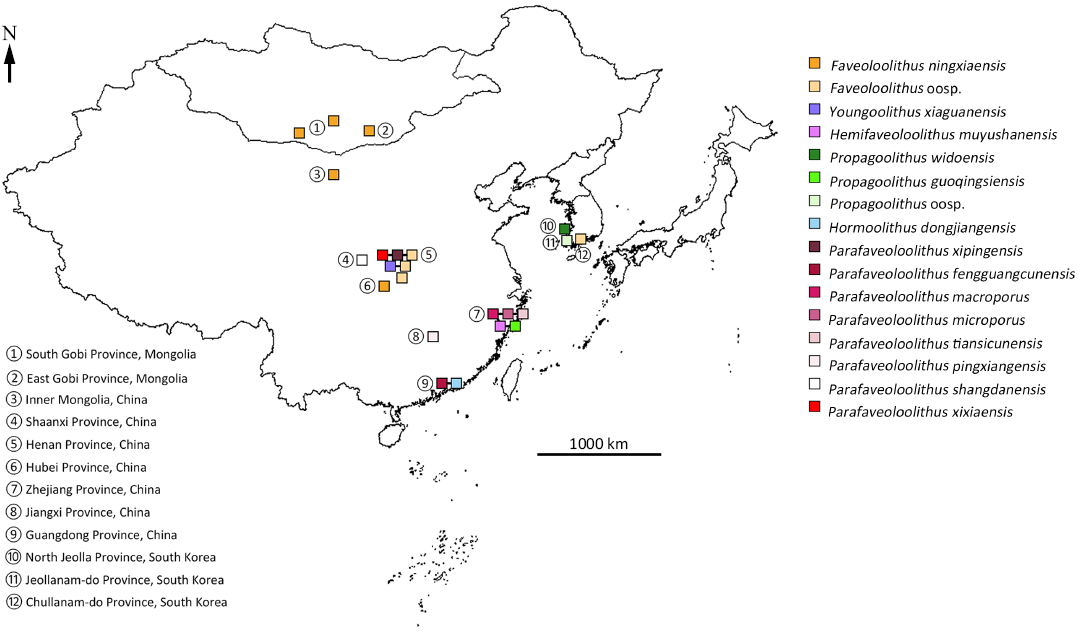
Fig. 8. Geographic distribution of Faveoloolithidae in East Asia.
Clutch structure of Parafaveoloolithus xixiaensis oosp. nov.—Only a small number of faveoloolithid oospecies have been found preserving clutch structures, including Faveoloolithus ningxiaensis (Zhao and Ding 1976), Youngoolithus xiaguanensis (Zhao 1979; Zhang 2010), Hemifaveoloolithus muyushanensis (Wang et al. 2011), and Propagoolithus guoqingsiensis (Wang et al. 2011). Although Parafaveoloolithus has the highest oospecies diversity among Faveoloolithidae and a widespread distribution across several basins (Fig. 8), no clutches of Parafaveoloolithus have been found to date. Parafaveoloolithus xixiaensis oosp. nov. from the Xixia Basin has a well-preserved clutch, representing the first clutch of Parafaveoloolithus. It also exhibits the best preserved clutch with complete eggs among faveoloolithid egg clutches, except for the doubtful oogenus Youngoolithus (Zhao et al. 2015). Therefore, clutch structure of P. xixiaensis oosp. nov. can reveal the nesting behavior of the dinosaur clade that laid Parafaveoloolithus and further shows differences with other faveoloolithid egg clutches in terms of clutch geometry and egg arrangement. However, clutch geometry may be used to infer nesting style to some degree and an actual sedimentary nest structure was not preserved.
The clutch of P. xixiaensis oosp. nov. is subcircular in shape, with a length of 62 cm and a width of 53 cm. This is different from the irregularly shaped clutch of Faveoloolithus ningxiaensis (Zhao et al. 2015) and the subrectangular clutch of Youngoolithus xiaguanensis (Zhao 1979; Zhang 2010). Although the clutch shapes of Hemifaveoloolithus muyushanensis and Propagoolithus guoqingsiensis remain unknown due to the incomplete preservation, their clutches, composed of randomly arranged and vertically stacked eggs, differ from the planar arrangement of P. xixiaensis oosp. nov. (Fig. 2), a pattern also present in F. ningxiaensis and Y. xiaguanensis (Zhao et al. 2015). In contrast to the parallel alignment of egg long axes in the clutch of Y. xiaguanensis (Zhao 1979), the eggs of P. xixiaensis oosp. nov. clutch exhibit random orientations, suggesting that the clutch was preserved in situ rather than transported over long distances by water flow. In view of the subcircular arrangement and high porosity of eggs, we infer that the female dinosaur laid the eggs in a subcircular pattern and subsequently covered them with sand (Zhao 1979; Deeming 2006), which likely contributed to the well-preserved condition of the clutch.
Conclusions
The dinosaur eggs from the Upper Cretaceous Zhaoying Formation in the Xixia Basin, Henan Province, China, are referable to a new oospecies Parafaveoloolithus xixiaensis of Faveoloolithidae based on their subspherical shape, small length-width values, irregular arrangement in the clutch, slender eggshell units and straight pore canals, and secondary eggshell units in the radial thin sections.
Duovallumoolithus shangdanensis and Parafaveoloolithus guoqingsiensis were reassigned to Parafaveoloolithus shangdanensis comb. nov. and Propagoolithus guoqingsiensis, respectively on the basis of their macro and microstructures. At present, the amended Parafaveoloolithus is composed of eight oospecies: P. microporus, P. macroporus, P. tiansicunensis, P. pingxiangensis, P. xipingensis, P. fengguangcunensis, P. shangdanensis comb. nov., and P. xixiaensis oosp. nov.
The distribution of Faveoloolithidae is mainly concentrated in Inner Mongolia, Hubei, Henan, Shaanxi, Zhejiang, Guangdong and Jiangxi provinces, China; Khermiyn-Tsav; Ologoy-Ulan-Tsav; Ikh-Shunkht, and Khuren-Dukh localities, Mongolia; Chullanam-do and North Jeolla provinces, South Korea. The clutch structure of P. xixiaensis oosp. nov. provides insight into the nesting behavior of the egg-laying dinosaur and we further speculate that it laid eggs in a subcircular pattern and then covered them with sand. The discovery of P. xixiaensis oosp. nov. provides new materials and the first complete clutch of Parafaveoloolithus and enriches the diversity of faveoloolithid eggs in East Asia.
Acknowledgements
We thank Guo-wang Li (Dinosaur Egg Fossil Administration Bureau of Xixia County, Nanyang City, Henan Province, China) for sample collection and anonymous reviewers for their careful reading and valuable comments on the manuscript. This research was supported by the National Natural Science Foundation of China (No. 41802006); the University Natural Science Research Project of Anhui Province (No. KJ2021A0086); the Foundation from the State Key Laboratory of Palaeobiology and Stratigraphy (Nanjing Institute of Geology and Palaeontology, CAS) (No. 213104) and Innovation and entrepreneurship training program for college students of Anhui University (No. X20241010).
Editor: Daniel Barta
References
Choi, S., Park, Y., Kweon, J.J., Kim, S., Jung, H., Lee, S.K., and Lee, Y.N. 2021. Fossil eggshells of amniotes as a paleothermometry tool. Palaeogeography, Palaeoclimatology, Palaeoecology 571: 110376. Crossref
Deeming, D.C. 2006. Ultrastructural and functional morphology of eggshells supports the idea that dinosaur eggs were incubated buried in a substrate. Palaeontology 49: 171–185. Crossref
Fang, X.S., Cheng, Z.W., Zhang, Z.J., Pang, Q.Q., Han, Y.J., Xie, H.L., and Li, P.X. 2007a. Evolutionary series of dinosaur eggs and environmental changes in southwestern Henan-northwestern Hubei [in Chinese with English abstract]. Acta Geoscientica Sinica 28: 97–110.
Fang, X.S., Lu, L.W., Cheng, Z.W., Zou, Y.P., Pang, Q.Q., Wang, Y.M., Chen, K.Q., Yin, Z., Wang, X.H., Liu, J.R., Xie, H.L., and Jin, Y.G. 1998. On the Cretaceous Fossil Eggs of Xixia County, Henan Province. [in Chinese with English abstract]. 125 pp. Geological Publishing House, Beijing.
Fang, X.S., Wang, Y.Z., and Jiang, Y.G. 2000. On the Late Cretaceous fossil eggs of Tiantai, Zhejiang [in Chinese with English abstract]. Geological Review 46: 105–112.
Fang, X.S., Zhang, Z.J., Pang, Q.Q., Li, P.X., Han, Y.J., Xie, H.L., Yan, R.H., Pang, F.J., Lv, J.L., and Cheng, Z.W. 2007b. Cretaceous strata and egg fossils in Xixia Basin, Henan Province [in Chinese with English abstract]. Acta Geoscientica Sinica 28: 123–142.
Fang, X.S., Zhang, Z.J., Zhang, X.Q., Lu, L.W., Han, Y.J., and Li, P.X. 2005. Fossil eggs from the Heyuan basin, east-central Guangdong, China [in Chinese with English abstract]. Geological Bulletin of China 24: 682–686.
Grellet-Tinner, G. and Fiorelli, L.E. 2010. A new Argentinean nesting site showing neosauropod dinosaur reproduction in a Cretaceous hydrothermal environment. Nature Communications 1: 32. Crossref
Grellet-Tinner, G., Fiorelli, L.E., and Salvador, R.B. 2012. Water vapor conductance of the Lower Cretaceous dinosaurian eggs from Sanagasta, La Rioja, Argentina: paleobiological and paleoecological implications for South American faveoloolithid and megaloolithid eggs. Palaios 27: 35–47. Crossref
He, Q., Yang, S., Jia, S.H., Xu, L., Xing, L.D., Gao, D.S., Liu, D., Gao, Y.L., and Zheng, Y.L. 2020. Trace element and isotope geochemistry of macroelongatoolithid eggs as an indicator of palaeoenvironmental reconstruction from the Late Cretaceous Xixia Basin, China. Cretaceous Research 109: 104373. Crossref
He, Q., Zhang, S.K., Xing, L.D., Jiang, Q., An, Y.F., and Yang, S. 2019. A new oogenus of Dendroolithidae from the Late Cretaceous in the Quyuangang Area, Henan Province, China. Acta Geologica Sinica (English Edition) 93: 477–478. Crossref
Huh, M. and Zelenitsky, D.K. 2002. Rich dinosaur nesting site from the Cretaceous of Bosung County, Chullanam-do Province, South Korea. Journal of Vertebrate Paleontology 22: 716–718. Crossref
Imai, T., Azuma, Y., and Yukawa, H. 2021. New Early Cretaceous dinosaurian eggshell Multifissoolithus shimonosekiensis (Dinosauria, Dongyangoolithidae) from the Lower Cretaceous of Shimonoseki, Yamaguchi, Southwestern Japan. Historical Biology 33: 1760–1766. Crossref
Jia, S.H., Fang, K.Y., Gao, D.S., Gao, Y.L., Chang, H.L., Chang, F., Xiao, L., Yang, L.L., Zheng, Y.L., Zhu, X.F., Wang, Q., and Wang, X.L. 2020. A new oospecies of dinosaur eggs from the Upper Cretaceous in the Xichuan Basin, Henan Province [in Chinese with English abstract]. Acta Geologica Sinica 94: 2816–2822.
Jo, H., Jung, J., Kim, M., Kim, B.S., Woo, Y., Ju, S.Y., and Huh, M. 2023. Preliminary study on the dinosaur egg nests from Jaeun Island, Sinan (Shinan)-gun, Jeollanam-do of South Korea [in Korean with English abstract]. Journal of the Geological Society of Korea 59: 441–451. Crossref
Kim, N.H., Choi, S., Kim, S., and Lee Y.N. 2019. A new faveoloolithid oogenus from the Wido Volcanics (Upper Cretaceous), South Korea and a new insight into the oofamily Faveoloolithidae. Cretaceous Research 100: 145–163. Crossref
Kim, S., Hwang, I.G., Ghim, Y.S., Kim, N.H., and Lee, Y.N. 2022. Upper Cretaceous (Coniacian–Santonian) dinosaur nesting colony preserved in abandoned crevasse splay deposits, Wi Island, South Korea. Palaeogeography, Palaeoclimatology, Palaeoecology 585: 110728. Crossref
Li, G., Chen, P.J., Wang, D.Y., and Batten, D.J. 2009. The spinicaudatan Tylestheria and biostratigraphic significance for the age of dinosaur eggs in the Upper Cretaceous Majiacun Formation, Xixia Basin, Henan Province, China. Cretaceous Research 30: 477–482. Crossref
Li, Y.X., Yin, Z.K., and Liu, Y. 1995. The discovery of a new genus of dinosaur egg from Xixia, Henan, China [in Chinese with English abstract]. Journal of Wuhan Institute of Chemical Technology 17: 38–40.
Liang, X.Q., Wen, S.N., Yang, D.S., Zhou, S.Q., and Wu, S.C. 2009. Dinosaur eggs and dinosaur egg-bearing deposits (Upper Cretaceous) of Henan Province, China: Occurrences, palaeoenvironments, taphonomy and preservation. Progress in Natural Science 19: 1587–1601. Crossref
Mikhailov, K.E. 1994. Eggs of sauropod and ornithopod dinosaurs from the Cretaceous deposits of Mongolia. Paleontological Journal 28: 141–159.
Sander, P.M., Petiz, C., Jackson, F.D., and Chiappe, L.M. 2008. Upper Cretaceous titanosaur nesting sites and their implications for sauropod dinosaur reproductive biology. Palaeontolgraphica Abteilung A 284: 69–107. Crossref
Sochava, A.V. 1969. Dinosaur eggs from the Upper Cretaceous of the Gobi desert [in Russian]. Paleontologičeskij žurnal 1969 (4): 517–527.
Tanaka, K., Zelenitsky, D.K., Saegusa, H., Ikeda, T., DeBuhr, C.L., and Therrien, F. 2016. Dinosaur eggshell assemblage from Japan reveals unknown diversity of small theropods. Cretaceous Research 57: 350–363. Crossref
Uematsu, R., Tanaka, K., Kozu, S., Isaji, S., and Shimojima, S. 2023. Fossil eggshells from the Early Cretaceous Okurodani Formation, northern central Japan. Historical Biology 35: 2396–2407. Crossref
Wang, D.Y., Feng, J.C., Zhu, S.G., Wu, M., Fu, G.H., He, P., Qiao, G.C., Pang, F.J., Li, G.W., Li, B.X., Li, J.K., Wang, B.X., Zhang, G.J., Qin, Z., and Guo, G.L. 2008. The Dinosaur Eggs and Dinosaurs of Henan Province, China [in Chinese with English abstract]. 320 pp. Geological Publishing House, Beijing.
Wang, Q., Du, Y.L., Fang, K.Y., Zhu, X.F., Jiang, A.C., Huang, Z.Q., and Wang, X.L. 2022. The Heyuan Dinosaur egg oofauna in Guangdong [in Chinese with English abstract]. 127 pp. Shanghai Science and Technology Press, Shanghai.
Wang, Q., Wang, X.L., Zhao, Z.K., and Jiang, Y.G. 2012. A new oofamily of dinosaur egg from the Upper Cretaceous of Tiantai Basin, Zhejiang Province, and its mechanism of eggshell formation. Chinese Science Bulletin 57: 3740–3747. Crossref
Wang, Q., Zhao, Z.K., Wang, X.L., and Jiang, Y.G. 2011. New ootypes of dinosaur eggs from the Late Cretaceous in Tiantai Basin, Zhejiang Province, China. Vertebrata PalAsiatica 49: 446–449.
Wang, X.L., Wang, Q., Jiang, S.X., Cheng, X., Zhang, J.L., Zhao, Z.K., and Jiang, Y.G. 2012. Dinosaur egg faunas of the Upper Cretaceous terrestrial red beds of China and their stratigraphical significance. Journal of Stratigraphy 36: 400–416.
Wilson, H.M., Heck, C.T., Varricchio, D.J., Jackson, F.D., and Jin, X. 2014. Evaluating deformation in Spheroolithus dinosaur eggs from Zhejiang, China. Historical Biology 26: 173–182. Crossref
Zhang, S.K. 2010. A parataxonomic revision of the Cretaceous faveoloolithid eggs of China [in Chinese with English abstract]. Vertebrata PalAsiatica 48: 203–219.
Zhang, Y.G. and Li, K. 1998. The dinosaur egg fossils in China and their ecostratigraphy [in Chinese with English abstract]. Sedimentary Facies and Palaeogeography 18: 32–38.
Zhao, H. and Zhao, Z.K. 1998. Dinosaur eggs from Xichuan Basin, Henan Province [in Chinese with English abstract]. Vertebrata PalAsiatica 36: 282–296.
Zhao, Z.K. 1979. Discovery of the dinosaurian eggs and footprint from Neixiang County, Henan Province [in Chinese with English abstract]. Vertebrata PalAsiatica 17: 304–309.
Zhao, Z.K. and Ding, S.R. 1976. Discovery of the dinosaur eggs from Alashanzuoqi and its stratigraphical meaning [in Chinese]. Vertebrata PalAsiatica 14: 42–44.
Zhao, Z.K., Wang, Q., and Zhang, S.K. 2015. Palaeovertebrata Sinica, Volume II, Amphibians, Reptilians, and Avians, Fascicle 7 (Serial no. 11): Dinosaur Eggs [in Chinese]. 172 pp. Science Press, Beijing.
Zheng, T.T., Bai, Y., Wang, Q., Zhu, X.F., Fang, K.Y., Yao, Y., Zhao, Y.Q., and Wang, X.L. 2018. A new ootype of dinosaur egg (Faveoloolithidae: Duovallumoolithus shangdanensis oogen. et oosp. nov.) from the Late Cretaceous in the Shangdan Basin, Shaanxi Province, China. Acta Geologica Sinica (English Edition) 92: 897–903. Crossref
Zhou, S.Q. and Feng, Z.J. 2002. Studies on the occurrence beds of oolithus and their relations to the upper–lower boundaries in Henan Province [in Chinese with English abstract]. Resources Survey & Environment 23: 68–76.
Zhou, S.Q. and Han, S.J. 1993. A study of dinosaur eggs from Henan Province [in Chinese]. Henan Geology 11: 44–51.
Zhou, S.Q., Feng, Z.J., and Hui, Y.X. 2001a. A study of dinosaurian fossil eggs from the Xixia Basin, Henan [in Chinese with English abstract]. Jiangxi Geology 15: 96–101.
Zhou, S.Q., Feng, Z.J., and Zhang, G.J. 2001b. Oolithias assemblages in Henan Province and its age significances [in Chinese with English abstract]. Geoscience 15: 362–369.
Zhou, S.Q., Li, Z.Y., Feng, Z.J., and Wang, D.Y. 1999. Oolithia of dinosaurs distributed in the Xixia Basin of Henan Province and its buried features [in Chinese with English abstract]. Geoscience 13: 298–300.
Zhou, X.G., Ren, Y.F., Xu, S.Q., and Guan, K.N. 1998. Dinosaur eggs of the Late Cretaceous from the Qinglongshan region, Yunxian County, Hubei Province [in Chinese with English abstract]. Hubei Geology & Mineral Resources 12: 1–8.
Zou, S.L., Wang, Q., and Wang, X.L. 2013. A new oospecies of parafaveoloolithids from the Pingxiang Basin, Jiangxi Province of China [in Chinese with English abstract]. Vertebrata PalAsiatica 51: 102–106.
Acta Palaeontol. Pol. 70 (4): 795–810, 2025
https://doi.org/10.4202/app.01221.2024