
The Middle Miocene musteloid Trochotherium cyamoides and the evolution of bunodont dentition in stem mephitids
DIEGO SÁNCHEZ-HERNÁNDEZ, ANDRÉS FERNÁNDEZ-REYES, MIGUEL PARRA, SERDAR MAYDA, M. ÁNGELES ÁLVAREZ-SIERRA, and ALBERTO VALENCIANO
Sánchez-Hernández, D., Fernández-Reyes, A., Parra, M., Mayda, S., Álvarez-Sierra, M.A., and Valenciano, A. 2026. The Middle Miocene musteloid Trochotherium cyamoides and the evolution of bunodont dentition in stem mephitids. Acta Palaeontologica Polonica 71 (3): 431–448.
The enigmatic musteloid species Trochotherium cyamoides is a poorly understood carnivoran that has been found at several fossil sites in Europe dating exclusively to the latest Middle Miocene (MN 7/8). Newly described material of T. cyamoides from La Grive-Saint-Alban (France) and Kleineisenbach (Germany) lead to a comprehensive re-evaluation of the species and the designation of a lectotype and paralectotype from the Steinheim am Albuch type locality. The highly derived dentition of Trochotherium obscures its systematic position. Nevertheless, the morphology of the upper fourth premolar (P4) and the presence of accessory rootlets in the lower carnassial (m1) indicate an affinity with the family Mephitidae. In contrast, the bunodont morphology of the upper first molar (M1) and the m1 suggests that T. cyamoides represents a stem mephitid, closely related to the Early Miocene Miomephitis from Wintershof-West (Germany) and especially to the Late Miocene Neoyunnanotherium from Lufeng and Yuanmou (China). While previously interpreted as a semi-aquatic molluscivorous mammal, we find that its unique dental morphology among Carnivora is more similar to that of certain snail-eating marsupials and lizards, leading us to suggest that it fed primarily on terrestrial gastropods.
Key words: Mammalia, Mephitidae, Miomephitis, Neoyunnanotherium, durophagy, Miocene, Germany, France.
Diego Sánchez-Hernández [diesan11@ucm.es; ORCID: https://orcid.org/0009-0000-9840-7148 ] (corresponding author), Andrés Fernández-Reyes [andfer39@ucm.es; ORCID: https://orcid.org/0009-0004-4866-0670 ], Miguel Parra [migupa01@ucm.es; ORCID: https://orcid.org/0009-0000-2828-5915 ], and M. Ángeles Álvarez-Sierra [masierra@ucm.es; ORCID: https://orcid.org/0000-0002-2649-5887 ], Departamento de Geodinámica, Estratigrafía y Paleontología, Facultad de Ciencias Geológicas, Universidad Complutense de Madrid, Madrid, Spain.
Serdar Mayda [serdar.mayda@ege.edu.tr, ORCID: https://orcid.org/0000-0001-5432-3559 ], Department of Biology, Ege University, İzmir, Turkey.
Alberto Valenciano [albvalen@ucm.es; ORCID: https://orcid.org/0000-0003-1633-2248 ] (corresponding author), Departamento de Geodinámica, Estratigrafía y Paleontología, Facultad de Ciencias Geológicas, Universidad Complutense de Madrid, Madrid, Spain; Research and Exhibitions, Iziko Museums of South Africa, 25 Queen Victoria Street, Cape Town, South Africa.
Received 23 February 2026, accepted 28 April 2026, published online 30 July 2026.
Copyright © 2026 D. Sánchez-Hernández et al. This is an open-access article distributed under the terms of the Creative Commons Attribution License (for details please see http://creativecommons.org/licenses/by/4.0/), which permits unrestricted use, distribution, and reproduction in any medium, provided the original author and source are credited.
Introduction
Trochotherium cyamoides Fraas, 1870, is an enigmatic medium-sized member of the superfamily Musteloidea with an extreme bunodont adaptation, found exclusively in the uppermost Middle Miocene (MN 7/8) of Europe. It was first described in the German locality of Steinheim am Albuch (MN 7/8; Fraas 1870; Helbing 1936; Heizmann 1973), and has subsequently been found in Opole-1 (Poland, MN 7/8; Wegner 1913), La Grive-Saint-Alban (France, MN 7/8; Viret 1935, 1951; Mein and Ginsburg 2002) and Anwil (Switzerland, MN 7/8; Engesser 1972) (Fig. 1). The systematic classification of T. cyamoides has also been a subject of debate. Wolsan (1999) proposed that T. cyamoides is a junior synonym of the primitive skunk Palaeomephitis steinheimensis Jäger, 1839. These two species are of similar size and have been found in the same type locality (Steinheim am Albuch). Palaeomephitis steinheimensis possesses an expanded epitympanic recess that may represent a predecessor of the enlarged mastoid sinus seen in later mephitids (Wolsan 1999; Wang et al. 2005), and its bulla has a more inflated entotympanic than in modern members of this family. However, as the synonymy with T. cyamoides was based on a fragmentary skull of P. steinheimensis without dentition (Wolsan 1999), other authors still consider T. cyamoides a valid taxon (Robles et al. 2010; Deshmukh and Valenciano 2022). Regarding its family and subfamily rank, some authors have interpreted T. cyamoides as a mustelid, either as part of the subfamilies Melinae Bonaparte, 1838 (Wegner 1913; Viret 1935; Helbing 1936; Heizmann 1973) or Leptarctinae Gazin, 1936 (sensu Qiu and Schmidt-Kittler 1982; see also Ginsburg 1999; Bonis 2005), or as a stem Mustelidae (Schmidt-Kittler 1981; Qiu and Schmidt-Kittler 1982). However, others consider it to be a member of the Mephitidae (Dehm 1950; Wolsan 1999; Robles et al. 2010) or a stem Mephitidae (Deshmukh and Valenciano 2022).
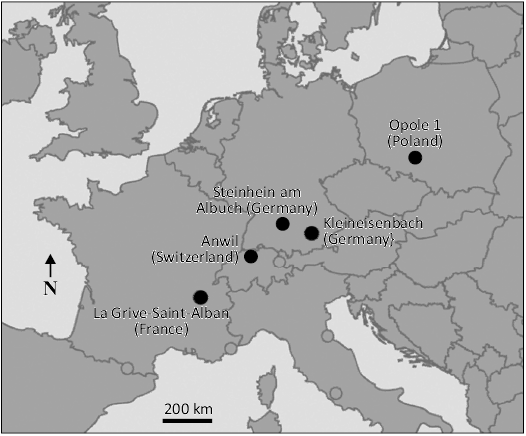
Fig. 1. Fossil sites where Trochotherium cyamoides Fraas, 1870, has been described from. Map created using the MapChart website.
The bunodont dentition of T. cyamoides has been interpreted by numerous authors as ideal for a durophagous diet (Fraas 1870; Viret 1935; Helbing 1936; Heizmann 1973; Ginsburg 1999; Deshmukh and Valenciano 2022). Other Miocene musteloids with similar dental adaptations are the Early Miocene Miomephitis pilgrimi Dehm, 1950 (Wintershof-West, Germany, MN 3) and the Late Miocene Neoyunnanotherium lufengense (Qi, 2014) (China, c. MN 12–13). Deshmukh and Valenciano (2022) suggested recently that these three genera could have comprised an extinct lineage of bunodont stem mephitids.
This study aims to document new fossil material of T. cyamoides from France and Germany, reexamine the previously described La Grive-Saint-Alban specimens, and assess the systematic position and dietary ecology of this highly specialized carnivoran.
Institutional abbreviations.—FMNH, Field Museum of Natural History, Chicago, USA; GPIT, Palaeontological Collections of the University of Tübingen, Germany; IPS, collections of the ICP (Institut Català de Paleontologia Miquel Crusafont), formerly known as Institut de Paleontologia de Sabadell, Cerdanyola del Vallès, Spain; LACMNH, Los Angeles County Natural History Museum, Los Angeles, USA; MdC, Musée des Confluences, Lyon, France; NHMW, Naturhistorisches Museum Wien, Austria; NRM, Naturhistoriska Riksmuseet, Stockholm, Sweden; ONM, Palaeontological collections of the Museum of the Office National des Mines, Tunis, Tunisia; QM, Palaeontological collections of the Queensland Museum, Brisbane, Australia; SMNS, Staatliches Museum für Naturkunde Stuttgart, Germany; SNSB-BSPG, Bavarian State Collection for Paleontology and Geology, Munich, Germany; UC, University of California, Berkeley, USA; UCBL-FSL, Collections of the Université Claude-Bernard Lyon 1, France; USNM, Smithsonian National Museum of Natural History, Washington D.C., USA.
Other abbreviations: We follow standard convention in abbreviating tooth families as I, C, P, and M, with upper and lower case letters referring to upper and lower teeth, respectively.
Geological setting
La Grive-Saint-Alban constitutes a group of Upper Aragonian (Middle Miocene) karst deposits located in the village of Saint-Alban-de-Roche (Isère, France), about 30 km to the southeast of Lyon (Filhol 1883; Depéret 1892; Viret 1933, 1951, 1961; Mein and Ginsburg 2002). This site is formed by a series of quarries, named Lechartier, Milliat, and Peyre et Beau. Here, the Jurassic limestone hosts abundant karst caves filled with siderolithic clay containing a rich variety of tetrapod remains attributed to the MN 7/8 biozone (Filhol 1883; Depéret 1892; Viret 1933, 1951, 1961; Mein and Ginsburg 2002). The Milliat quarry provides the reference fauna for this biozone (de Bruijn et al. 1992; Mein and Ginsburg 2002). The Lechartier quarry has multiple levels numbered L1 to L8, but only L3, L5, L5′, L6, and L7 contain fossils (Mein and Ginsburg 2002; López-Antoñanzas and Mein 2011). Even though all the quarries are roughly of the same age (MN 7/8), the M (Milliat quarry) and L7 fissures belong to an earlier point in time (MN 7) than the L3 and L5 fissures (MN 8) (Mein and Ginsburg 2002; Pavia and Mourer-Chauviré 2011). The fauna found in this locality includes a wide diversity of mammals, including primates, insectivorans, bats, rodents, ungulates, and carnivorans, such as felids, barbourofelids, hyaenids, viverrids, ursids, amphicyonids, mustelids, mephitids, and ailurids (Mein and Ginsburg 2002).
The Kleineisenbach fossil site consists of a sand and marl pit, located about 12 km to the southeast of Freising, near Munich (Germany) (Fahlbusch 1975). It is part of the North Alpine foreland basin and can be correlated with the Swiss locality of Anwil (MN 7/8) (Engesser 1972; Prieto 2007, 2010). This vertebrate assemblage is dominated by small mammals, reptiles and amphibians (Black 1966; Fahlbusch 1975; de Bruijn et al. 1993; Prieto 2007, 2012; Klaus and Gross 2010).
Material and methods
The previously known fossils of Trochotherium cyamoides from La Grive-Saint-Alban (Viret 1935, 1951) come from the L7 level of the site (Mein and Ginsburg 2002). These fossils are two M1s and one m1. One of the M1s (MdC-LGR. 1300) is housed at the Musée des Confluences in Lyon (France). The other M1 (UCBL-FSL 540485, formerly Université 5020; Viret 1951) and the m1 (UCBL-FSL 540484, formerly Université 5019; Viret 1951) are part of the collections of the Université Claude-Bernard Lyon 1 (Lyon, France). The new mandibular remains and lower dentition of T. cyamoides described here (UCBL-FSL 540482, 540483, 540486, and 540488), come from the M level and are housed in the collections of the Université Claude-Bernard Lyon 1.
The new material of T. cyamoides from Kleineisenbach is a right hemimandible with an almost complete dentition (SNSB-BSPG-1972 XVI 317) housed at the Bavarian State Collection for Paleontology and Geology (Munich, Germany). The dental nomenclature used here broadly follows Ginsburg (1999) and Smith and Dodson (2003). We interpret the P4 lingual cusp of T. cyamoides and other mephitids as the protocone following Pilgrim (1933), Baskin (1998), Wang and Qiu (2004) and Wang and Carranza-Castañeda (2008); contrary to Geraads and Spassov (2016) and Araslanov and Lavrov (2024), who interpret it as the hypocone. Figure 2 shows the upper and lower first molars cusps, as well as the measurements of the M1.
The comparative material used includes fossils of T. cyamoides from Steinheim am Albuch (Fraas 1870, 1885; Helbing 1936; Heizmann 1973) housed at SMNS; Trocharion albanense Forsyth Major, 1903, from Devínska Nová Ves (Slovakia, MN 6; Sabol 2000) housed at NHMW; Miomephitis pilgrimi from Wintershof-West (Germany, MN 3; Dehm 1950) housed at SMNS and SNSB-BSPG; and Palaeomeles pachecoi Villalta Comella & Crusafont-Pairó, 1943, from Can Mata 1 (formerly Hostalets de Pierola) and Castell de Barberà (Spain, MN 9; Villalta Comella and Crusafont-Pairó 1943, 1944; Crusafont Pairó and Golpe Posse 1982) housed at IPS, and from Hammerschmiede (Germany, MN 7/8; Kargopoulos et al. 2022) housed at GPIT. We utilized a hemimandible cast of T. cyamoides from Anwil (Engesser 1972) housed at UCBL-FSL. Lastly, we studied T. cyamoides from Opole-1 (Wegner 1913), Neoyunnanotherium lufengense from Lufeng, Yunnan (Section D of the Lufengpithecus Locality, China, MN 12–13; Qi 2014), Malleodectes mirabilis Arena et al., 2011, from RRR Site (Riversleigh World Heritage Area, Queensland, Australia, upper Middle Miocene) (Arena et al. 2011; Archer et al. 2016); and Terastiodontosaurus marcelosanchezi Georgalis et al., 2024, from Chambi-1 (Djebel Chambi National Park, Tunisia, lower Middle Eocene) (Georgalis et al. 2024; Churchill et al. 2025) through their original publications. The extant comparative material includes Mephitis mephitis (Schreber, 1776) housed at FMNH; Mydaus javanensis (Desmarest, 1820) housed at FMNH; Procyon cancrivorus Cuvier, 1798, housed at NRM; and Enhydra lutris (Linnaeus, 1758) housed at USNM.
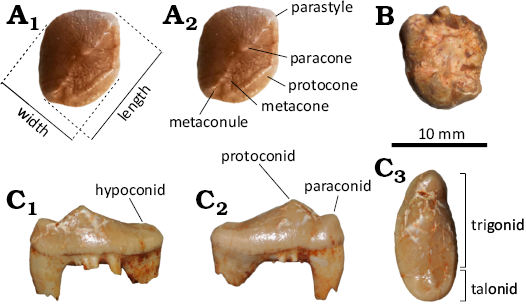
Fig. 2. Teeth nomenclature and measurements of the musteloid mammal Trochotherium cyamoides Fraas, 1870. A. Right M1 (MdC-LGR. 1300) in occlusal view. B. Right M1 (UCBL-FSL 540485) in basal view. C. Left m1 (UCBL-FSL 540488), in buccal (C1), lingual (C2), and occlusal (C3) views.
Systematic palaeontology
Order Carnivora Bowdich, 1821
Superfamily Musteloidea Fischer, 1817
Family Mephitidae Bonaparte, 1845
Genus Trochotherium Fraas, 1870
Type species: Trochotherium cyamoides Fraas, 1870; Middle Miocene (Aragonian, MN 7/8), Steinheim am Albuch.
Trochotherium cyamoides Fraas, 1870
Figs. 3–5.
Type material: Lectotype: designated herein, SMNS-P-16193, partial right maxilla with C, P3, P4 and M1 from Steinheim am Albuch (Fig. 3A; figured by Fraas 1885: pl. 4: 4). Paralectotype: designated herein, SMNS-P-5283, right hemimandible with c, p3, p4 and m1 from Steinheim am Albuch (Fig. 3B; figured by Fraas 1885: pl. 4: 5a, b).
Type locality: Steinheim am Albuch, Germany.
Type horizon: Middle Miocene, Aragonian, MN 7/8 (Fraas 1870, 1885; Helbing 1936; Heizmann 1973).
Emended diagnosis.—Carnivoran intermediate in size between Mephitis and Mydaus. Premolars unicuspid. P1, P2 absent. P3 reduced. P4 short, with a reduced and rounded protocone placed next to the paracone. M1 enlarged and sub-rhomboidal, with a bunodont and hyperdeveloped paracone occupying the central area of the crown; two crests extend from the paracone: one reaches the metacone and metaconule in the distolingual corner, and the other extends towards the parastyle in the mesiobuccal corner; very reduced protocone in the mesiolingual area, connected to a small cingulum in the lingual platform; presence of several accessory rootlets. p1 absent. p2, p3 reduced. p4 short and wide. m1 bunodont and elongated, with a low paraconid smaller than the protoconid; the distobuccal wall of the protoconid is elongated and forms an almost concave slope that reaches the hypoconid; two main roots and multiple accessory rootlets placed in the buccal and lingual edges. m2 small and rounded, with a single root.
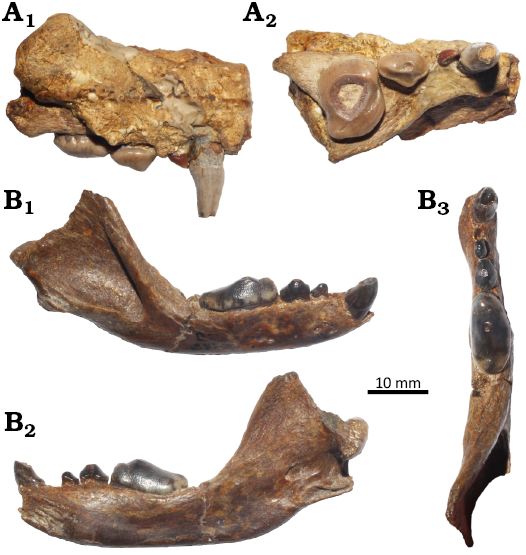
Fig. 3. Lectotype and paralectotype of the musteloid mammal Trochotherium cyamoides Fraas, 1870, from Middle Miocene, MN 7/8, Steinheim am Albuch, Germany. A. Lectotype, SMNS-P-16193, right maxilla in buccal (A1) and occlusal (A2) views. B. Paralectotype, SMNS-P-5283, right hemimandible in buccal (B1), lingual (B2), and occlusal (B3) views.
Material.—Seven specimens from La Grive-Saint-Alban, France, Middle Miocene, Aragonian, MN 7/8: MdC-LGR. 1300, right M1 from level L7 (Fig. 4A; Viret 1935, 1951); UCBL-FSL 540485, right M1 from level L7 (Fig. 4B; Viret 1935, 1951); UCBL-FSL 540484, left m1 from level L7 (Fig. 4C; Viret 1935, 1951); UCBL-FSL 540482, right m1 from level M (Fig. 4D); UCBL-FSL 540483, right m1 from level M (Fig. 4E); UCBL-FSL 540486, left m1 in association with a fragment of the masseteric fossa from level M (Fig. 4F, G); UCBL-FSL 540488, left m1 in association with the canine, part of the mandibular corpus, and the coronoid and articular processes from level M (Fig. 4H–K). One specimen from Kleineisenbach, Germany, Middle Miocene, MN 7/8: SNSB-BSPG-1972 XVI 317, fragmentary right hemimandible with c, p3, p4, m1 and alveolus of m2 (Fig. 4L).
Description.—Previously known material from La Grive-Saint-Alban, level L7: MdC-LGR. 1300 (Fig. 4A) is a right M1, sub-rhomboidal in shape and slightly wider than long, and it has a large paracone. Two thin crests depart from the paracone, connecting either to a small parastyle in the mesiobuccal corner of the tooth or to a small metacone in the distolingual corner. The metacone is placed next to a small metaconule.
UCBL-FSL 540485 (Fig. 4B) is a right M1 larger than MdC-LGR. 1300. Its occlusal facet is extremely worn and shows a mesiodistal fracture close to the buccal edge. The paracone is worn, with only its base remaining. The mesiolingual area of the tooth is fractured. The parastyle and metaconule are still present, but the metacone is absent. Both M1s have many small, accessory rootlets bordering the tooth. In the case of UCBL-FSL 540485, these accessory rootlets are broken at their base.
UCBL-FSL 540484 (Fig. 4C) is a left m1 with only three cuspids: paraconid, protoconid and hypoconid. The paraconid has a dome-like shape. The protoconid is situated in the middle of the buccolingual axis of the tooth and is much larger than the paraconid. Its distal wall is slightly concave and reaches the hypoconid, which is quite low. The m1 has large mesial and distal roots, as well as many additional rootlets in the buccal and lingual edges of the tooth; these rootlets are broken at their base.
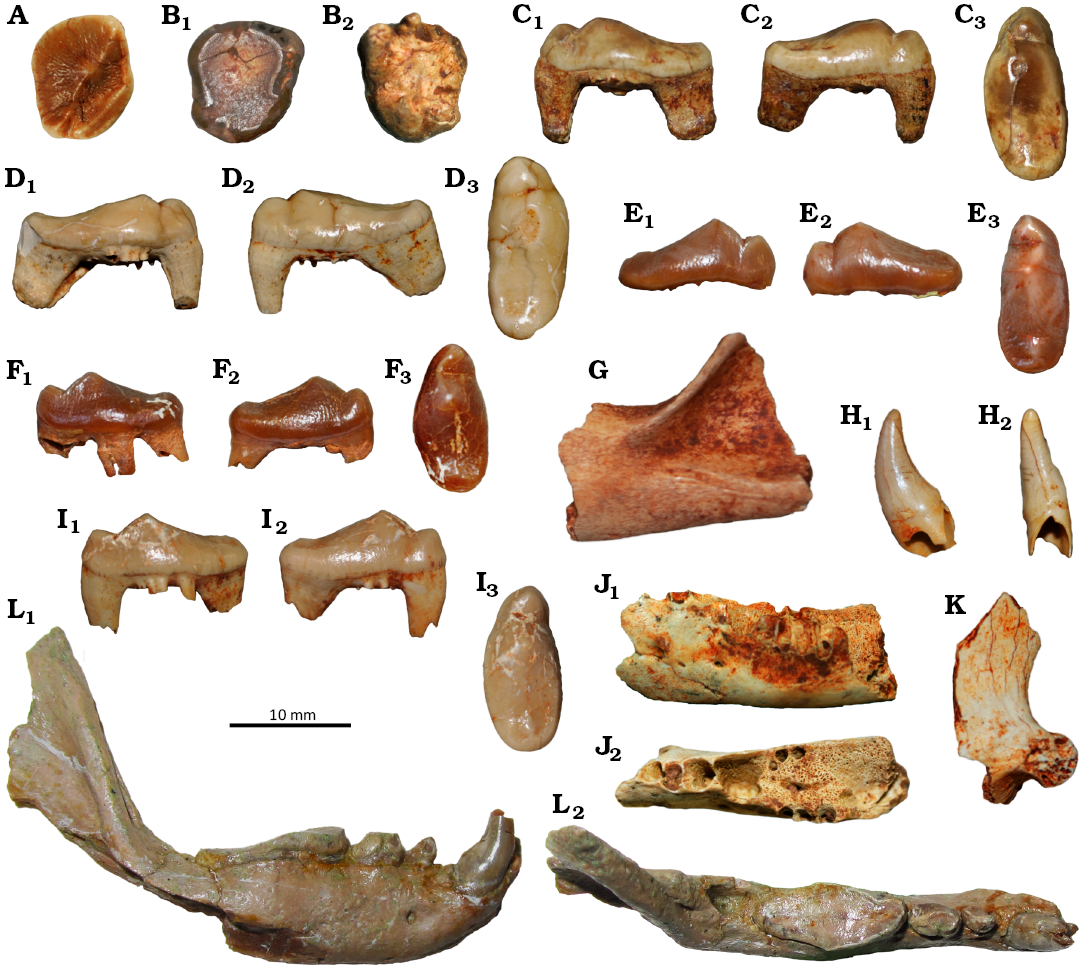
Fig. 4. Musteloid mammal Trochotherium cyamoides Fraas, 1870, from from the Middle Miocene (MN 7/8) of La Grive-Saint-Alban, France (A–K) and Kleineisenbach, Germany (L). A–C, classical material from level L7 of La Grive-Saint-Alban (Viret, 1935, 1951); D–K, new material from level M of La Grive-Saint-Alban. A. MdC-LGR. 1300, right M1 in occlusal view. B. UCBL-FSL 540485, right M1 in occlusal (B1) and basal (B2) views. C. UCBL-FSL 540484, left m1 in buccal (C1), lingual (C2), and occlusal (C3) views. D. UCBL-FSL 540482, right m1 in buccal (D1), lingual (D2), and occlusal (D3) views. E. UCBL-FSL 540483, right m1 in buccal (E1), lingual (E2), and occlusal (E3) views. F. UCBL-FSL 540486, left m1 in buccal (F1), lingual (F2), and occlusal (F3) views. G. Left masseteric fossa associated with the UCBL-FSL 540486 m1 in buccal view. H. UCBL-FSL 540488, canine associated with left m1 in buccal (H1) and distal (H2) views. I. UCBL-FSL 540488, left m1 in buccal (I1), lingual (I2), and occlusal (I3) views. J. Fragment of the mandibular corpus associated with the UCBL-FSL 540488 m1 in buccal (J1) and occlusal (J2) views. K. Coronoid and articular processes associated with the UCBL-FSL 540488 m1 in buccal view. L. SNSB-BSPG-1972 XVI 317, right hemimandible with the canine, p3, p4, and m1 in buccal (L1) and occlusal (L2) views.
New material from La Grive-Saint-Alban, level M: The four m1s vary in size (12.15–15.38 mm in length, 6.21–7.04 mm in width; Table 1). UCBL-FSL 540482 (Fig. 4D) shows a high degree of wear in the protoconid, while UCBL-FSL 540483 (Fig. 4E), and UCBL-FSL 540488 (Fig. 4I) are less worn. UCBL-FSL 540486 (Fig. 4F) possesses a tall, unworn hypoconid; this tooth is quite wide, possessing a lesser length/width ratio (1.97) than the other m1s (Table 1). The m1s have two large main roots (which are broken in UCBL-FSL 540483), as well as many additional rootlets. Almost all these additional rootlets are broken at their base, except for the buccal ones of UCBL-FSL 540486, which appear to be fused at their bases.
The specimen UCBL-FSL 540486 consists of the m1 and an associated mandibular fragment that includes the masseteric fossa (Fig. 4F, G). The specimen UCBL-FSL 540488 includes part of the mandibular ramus with the coronoid and articular processes, a canine with a missing root, and the m1 (Fig. 4H–K). The mandibular ramus is low. It shows alveoli for the distal root of the p3, the mesial and distal roots of the p4, and the mesial root and six accessory rootlets (three buccal and three lingual, close to the mesial root) of the m1. The alveolus for the distal root is not visible because there appears to be porous bone growth covering it. Both the coronoid and articular processes are broken.
New material from Kleineisenbach: The mandibular ramus is broken at its ventrocaudal border, and there is a mental foramen under the p3. The ascending ramus only preserves its cranial area, which is mediolaterally engrossed, suggesting a wide area for the insertion of the temporal muscle. The canine is robust and broken at the tip. There is a single small alveolus for the p2. The p3 possesses only a main cuspid, and it lacks part of the enamel on its buccal wall. Similar to the p3, the p4 possesses only one worn cuspid. The m1 is more worn than the p4, as its cuspids have disappeared, resulting in a flat occlusal surface. There is an alveolus for a single-rooted m2.
Stratigraphic and geographic range.—Middle Miocene (Aragonian, MN 7/8) from Steinheim am Albuch (Germany) (Fraas 1870, 1885; Helbing 1936; Heizmann 1973), Opole-1 (Poland) (Wegner 1913), La Grive-Saint-Alban (France) (Viret 1935, 1951; Mein and Ginsburg 2002), Anwil (Switzerland) (Engesser 1972), and Kleineisenbach (Germany) (Fahlbusch 1975).
Table 1. Measurements (in mm) of the teeth of Trochotherium cyamoides Fraas, 1870, from La Grive-Saint-Alban (MdC-LGR. 1300 through UCBL-FSL 540488) and Kleineisenbach (SNSB-BSPG-1972 XVI 317). L, length; W, width.
|
Specimen numbers |
M1 |
c |
p3 |
p4 |
m1 |
||||||
|
L |
W |
L |
W |
L |
W |
L |
W |
L |
W |
L / W |
|
|
MdC-LGR. 1300 |
7.70 |
10.80 |
|
|
|
|
|
|
|
|
|
|
UCBL-FSL 540485 |
10.22 |
11.62 |
|
|
|
|
|
|
|
|
|
|
UCBL-FSL 540482 |
|
|
|
|
|
|
|
|
15.38 |
7.04 |
2.20 |
|
UCBL-FSL 540483 |
|
|
|
|
|
|
|
|
13.35 |
6.28 |
2.13 |
|
UCBL-FSL 540484 |
|
|
|
|
|
|
|
|
15.34 |
6.80 |
2.25 |
|
UCBL-FSL 540486 |
|
|
|
|
|
|
|
|
12.15 |
6.21 |
1.97 |
|
UCBL-FSL 540488 |
|
|
4.91 |
3.75 |
|
|
|
|
14.08 |
6.70 |
2.10 |
|
SNSB-BSPG-1972 XVI 317 |
|
|
4.43 |
3.51 |
2.96 |
1.81 |
4.38 |
2.65 |
13.70 |
6.01 |
2.28 |
Discussion
Taxonomy and systematics.—The novel m1s of Trochotherium cyamoides from La Grive-Saint-Alban (level M) herein described (Fig. 4D–K) are very similar to the previously known m1 (UCBL-FSL 540484) of this species from the L7 level of the same locality (Viret 1935) (Fig. 4C). The specimens from both levels, which belong to the early MN 7/8 zone (Mein and Ginsburg 2002), share the diagnostic traits of the species, such as an overall bunodont morphology, a low paraconid, a protoconid with an elongated and concave distal wall, presence of several accessory rootlets, and lack of metaconid and entoconid. The mandible from Kleineisenbach (Fig. 4L) exhibits significant wear on the m1, resulting in the complete absence of its cuspids. However, the occlusal outline of the lower carnassial and the morphology of the p3 and p4 are identical to those of T. cyamoides from Steinheim am Albuch (Fraas 1885; Helbing 1936) (Fig. 5K).
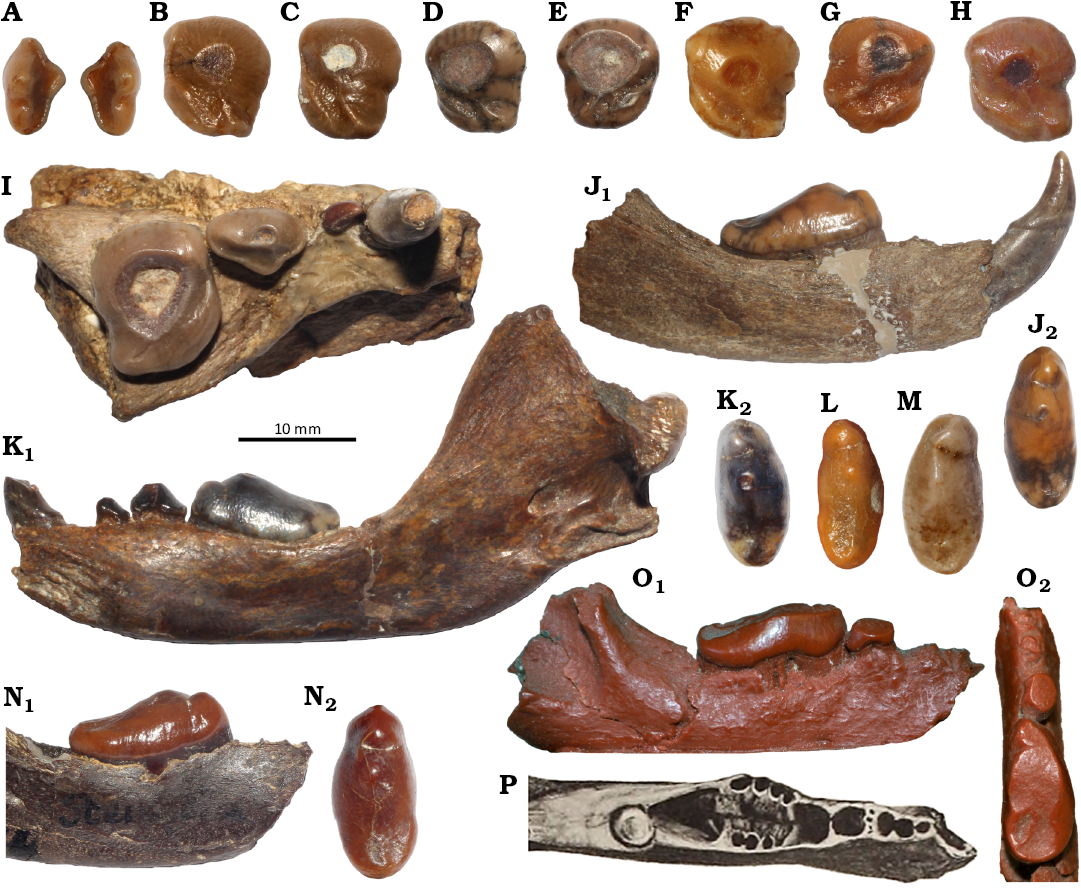
Fig. 5. Musteloid mammal Trochotherium cyamoides Fraas, 1870, from the Middle Miocene (MN 7/8) of Steinheim am Albuch, Germany (A-N), Anwil, Switzerland (O), and Opole-1, Poland (P). A. SMNS-P-5283b and SMNS-P-5283c, left and right P4s in occlusal view. B. SMNS-P-5042b, left M1 in occlusal view. C. SMNS-P-16187, left M1 in occlusal view. D. SMNS-P-5042c, left M1 in occlusal view. E. SMNS-P-5042d, right M1 in occlusal view. F. SMNS-P-5042a, right M1 in occlusal view. G. SMNS-P-8137, right M1 in occlusal view. H. SMNS-P-1921, left M1 in occlusal view. I. SMNS-P-16193, right maxilla with C, P3, P4 and M1 in occlusal view. J. SMNS-P-12223, left hemimandible with c and m1 in lingual view (J1), and m1 in occlusal view (J2). K. SMNS-P-5283, right hemimandible with c, p3, p4, and m1 in lingual view (K1), and m1 in occlusal view (K2). L. SMNS-P-16185, right m1 in occlusal view. M. SMNS-P-4391, left m1 in occlusal view. N. SMNS-P-16184, left hemimandible with m1 in lingual view (N1), and m1 in occlusal view (N2). O. Cast of UCBL-FSL Al. 166, right hemimandible with p4 and m1 in buccal (O1) and occlusal (O2) views. P. Image of a left hemimandible (unknown catalogue number; modified from Wegner 1913).
The known dentition of T. cyamoides (Fraas 1870, 1885; Wegner 1913; Viret 1935, 1951; Helbing 1936; Engesser 1972; Heizmann 1973; Mein and Ginsburg 2002) exhibits a certain degree of morphological variation. The specimens from Steinheim am Albuch possess the the P4 protocone close to the midpoint of the mesiodistal axis of the tooth, while Engesser (1972) described and illustrated a P4 from Anwil with the protocone in a more mesial position. The shortest recorded M1 of T. cyamoides comes from La Grive-Saint-Alban (MdC-LGR. 1300; 7.70 mm in length) (Fig. 6), and it has a less pronounced metaconule than in the individuals from Steinheim am Albuch (Fig. 5B–I). Some of the M1s from Steinheim am Albuch also have a more pronounced curvature in the midpoint of their distal wall (Fig. 5B, E, F, H), while in MdC-LGR. 1300 this distal wall is straighter (Fig. 4A). Regarding the lower dentition, the m1s from La Grive-Saint-Alban show less variation in width than those from Steinheim am Albuch, but both populations have a similar variation in length (Fig. 6E). The talonid width also shows variation in La Grive-Saint-Alban and Steinheim am Albuch, with some specimens having a narrower talonid (Figs. 4E, F, 5J, K, L) than others (Figs. 4C, D, I, 5M, N). The m1 from Kleineisenbach (Fig. 4L) as well as the single known m1 from Anwil (Fig. 5O), are completely worn, so comparing their cuspid morphology is not possible. Regarding their size, the specimen from Kleineisenbach is close to the center of the size range for this taxon, while the one from Anwil is shorter (Fig. 6). The specimen from Opole-1 (Fig. 5P) lacks the m1, but it shows the large number of accessory rootlets diagnostic of this species. Accordingly, the overlapping temporal ranges of T. cyamoides populations and the magnitude of variation documented in the Steinheim am Albuch and La Grive-Saint-Alban samples suggest that interpopulation and intralocality differences primarily reflect phenotypic plasticity. Within Musteloidea, the mustelids, procyonids and ailurids exhibit sexual dimorphism in their canine size, with the males possessing larger canines than the females (Gittleman and Van Valkenburgh 1997; Abramov and Puzachenko 2005; Korablev et al. 2013; Fulwood and Wallace 2015). Some extant mephitids, such as several species of the genus Conepatus, also display dental differences between males and females (Dragoo 2009), e.g., in the distance between the lower incisors and the length of the upper canines of Conepatus amazonicus (Machado et al. 2024). However, there are not enough known canines of T. cyamoides to determine if it also displayed sexual dimorphism.
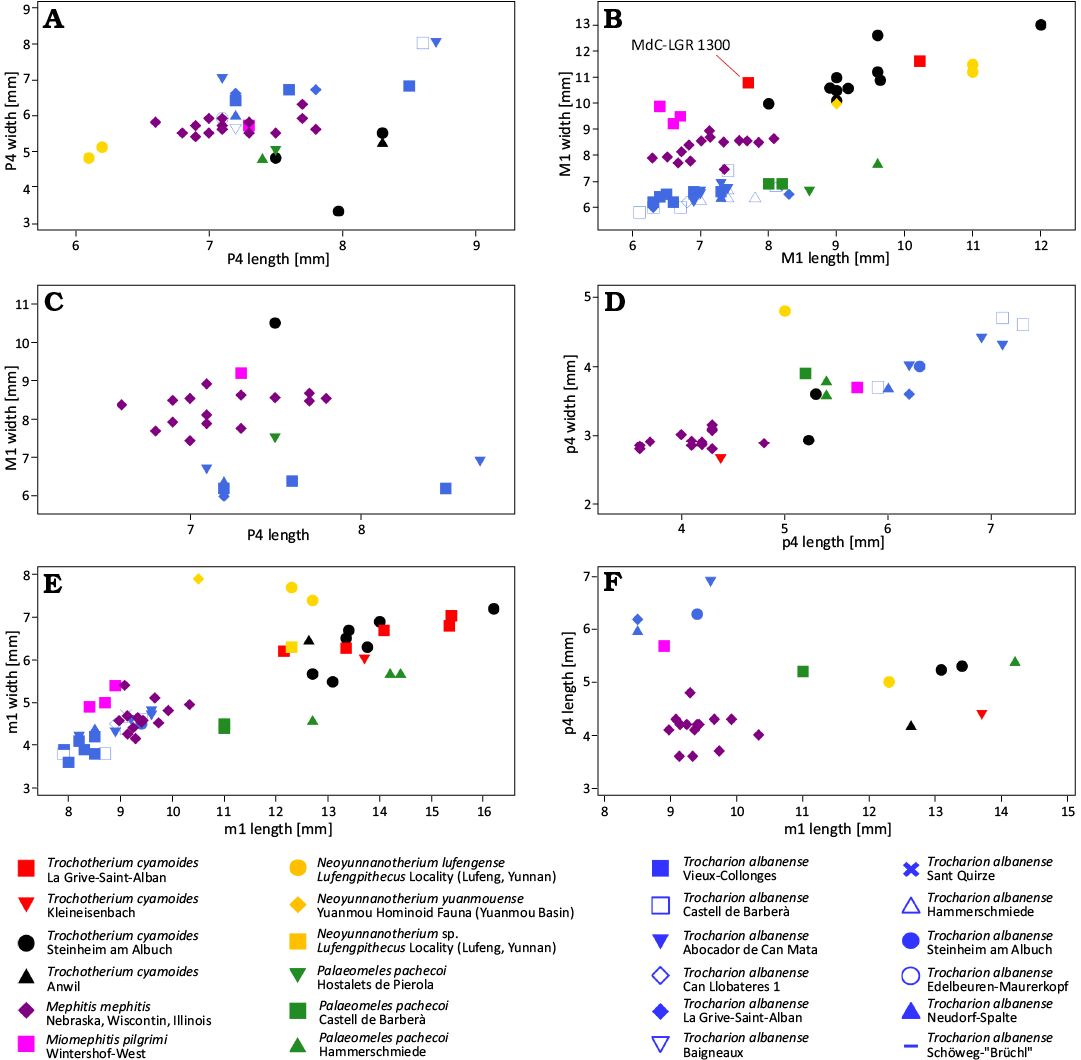
Fig. 6. Bivariate plots of the dentition of Trochotherium cyamoides Fraas, 1870 compared with the extant striped skunk (Mephitis mephitis), the Miocene Mephitidae Miomephitis pilgrimi, Neoyunnanotherium spp., Palaeomeles pachecoi, and the Leptarctinae Trocharion albanense. A. P4 length and width. B. M1 length and width. C. P4 length and M1 width. D. p4 length and width. E. m1 length and width. F. m1 length and p4 length. Values in mm. Sources: this work and Fraas (1870), Forsyth Major (1903), Wegner (1913), Pilgrim (1932), Helbing (1936), Villalta Comella and Crusafont-Pairó (1943), Viret (1946, 1951), Dehm (1950), Zapfe (1950), Mein (1958), Engesser (1972), Heizmann (1973), Crusafont Pairó and Golpe Posse (1982), Zong (1997), Robles et al. (2010), Qi (2014), Kargopoulos et al. (2022), and Prieto et al. (2022).
The distinct and highly bunodont dentition of T. cyamoides has made it difficult to discern its systematic position. Based on cranial and postcranial traits present in the fossils from Steinheim am Albuch, Viret (1935), Helbing (1936), and Heizmann (1973) recognized it as a Melinae, the Mustelidae subfamily that includes the Eurasian badgers. However, we do not consider T. cyamoides a member of this subfamily, as it differs from the current diagnosis of Melinae (see Wolsan and Sotnikova 2013) in many aspects: the bunodont dentition, the absence of P4 hypocone, the sub-rhomboidal shape of the M1, the short m1 talonid, and the absence of m1 metaconid, entoconid and hypoconulid. Other authors have classified it as a Leptarctinae mustelid according to its bunodont dentition (e.g., Ginsburg 1999; Bonis 2005). This is an extinct subfamily of bunodont mustelids from the Miocene of North America and Eurasia (e.g., Baskin 1998; Wang et al. 2004; Robles et al. 2010), with Trocharion albanense being the only European species (Qiu and Schmidt-Kittler 1982; Sabol 2000; Robles et al. 2010; Kargopoulos et al. 2022; Tseng 2025). It occurs alongside T. cyamoides in La Grive-Saint-Alban (Viret 1935, 1951) and Steinheim am Albuch (Helbing 1936). The coexistence of these two carnivorans has sometimes resulted in the misidentification of fossils of one taxon as belonging to the other. This was the case with the postcranial material from Steinheim am Albuch originally assigned to T. cyamoides (Helbing 1936), later transferred to Trocharion albanense by Qiu and Schmidt-Kittler (1982). Engesser (1972) described a complete ulna of T. cyamoides from Anwil which is very similar to the previously known ulna from Steinheim am Albuch (Helbing 1936). However, we consider that this ulna should be reclassified as Trocharion albanense, following the review of the material from Steinheim am Albuch (Qiu and Schmidt-Kittler 1982). Therefore, with all the postcranial fossils originally attributed to T. cyamoides now reclassified as Trocharion albanense, the postcranial morphology of T. cyamoides remains unknown, and the interpretations about its aquatic lifestyle (Helbing 1936; Ginsburg 1999) have no solid basis. Schmidt-Kittler (1981) and Qiu and Schmidt-Kittler (1982) considered T. cyamoides to be a stem mustelid instead of a crown member of this family, based on the procyonid-like structure of the middle ear region of a partial skull from Steinheim am Albuch, originally also misidentified as Trocharion albanense by Helbing (1936). Dental and mandibular morphology clearly distinguish T. cyamoides from Trocharion albanense, indicating that the two taxa are not closely related. The former has proportionally larger molars and more slender premolars (Fig. 6), whereas the latter is characterized by a molariform P4 with a shelf-like protocone, a subquadrate, crest-bearing M1, a complete m1 trigonid, a shorter mandibular corpus, enlarged p3–p4, and the absence of accessory rootlets on both M1 and m1 (Fig. 7A, B).
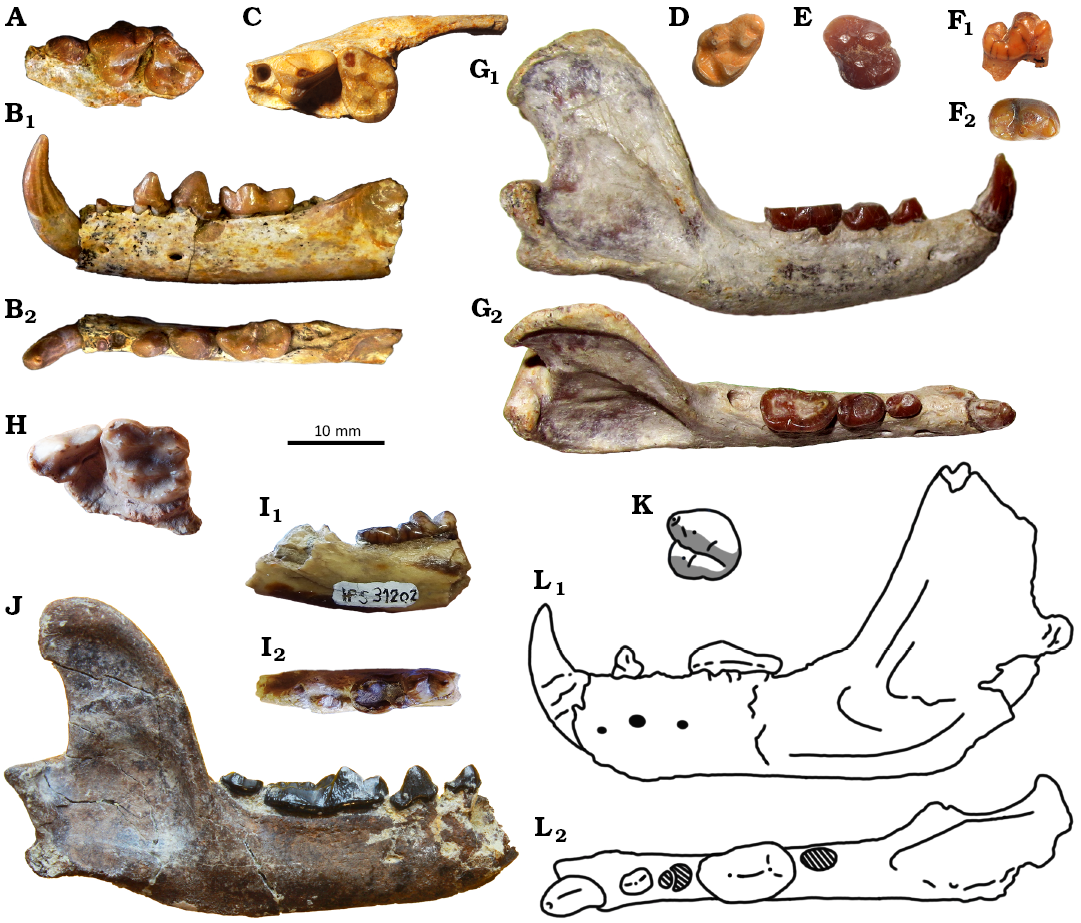
Fig. 7. Bunodont musteloids from the Miocene of Europe and China. A, B. Trocharion albanense Forsyth Major, 1903, from Devínska Nová Ves (Slovakia, MN6). A. NHMW 1976/1818, left maxilla with P3, P4 and M1 in occlusal view. B. NHMW 1976/1818, left hemimandible with p3, p4 and m1 in lingual (B1) and occlusal (B2) views. C–G. Miomephitis pilgrimi Dehm, 1950, from Wintershof-West (Germany, MN3). C. SNSB-BSPG-1938 V 21, left maxilla with P4 and M1 in occlusal view. D. SNSB-BSPG-1937 II 13397, right M1 in occlusal view. E. SNSB-BSPG-1937 II 13398, left M1 in occlusal view. F. SNSB-BSPG-1937 II 13326, left m1 in lingual (F1) and occlusal (F2) views. G. SNSB-BSPG-1937 II 13324, right hemimandible with c, p3, p4 and m1 in buccal (G1) and occlusal (G2) views. H–J. Palaeomeles pachecoi alta Comella & Crusafont-Pairó, 1943, from Can Mata 1 (Spain, MN 7/8) (H, I) and from Hammerschmiede (Germany, MN 7/8) (J). H. IPS697, left maxilla with P4 and M1 in occlusal view. I. IPS31202, left hemimandible with m1 in lingual (I1) and occlusal (I2) views. J. GPIT/MA/13711, right hemimandible with p3, p4, m1 and m2 in buccal view. K, L. Neoyunnanotherium lufengense from Lufeng, Yunnan (Section D of Lufengpithecus Locality, China, MN 12–13). K. V 1168-9, left M1 (modified from Qi 2014) in occlusal view. L. V 1168-11, left hemimandible with c, p3 and m1 (modified from Qi 2014) in buccal (L1) and occlusal (L2) views.
Lastly, T. cyamoides has been interpreted as closely related to Mephitidae (e.g., Dehm 1950; Wolsan 1999; Robles et al. 2010; Deshmukh and Valenciano 2022), interpretation herein followed. This family currently includes the American skunks and the Southeast Asian stink badgers, and has traditionally been considered a subfamily of Mustelidae close to Melinae (e.g., Muizon 1982; Bryant et al. 1993; Baskin 1998; Ginsburg 1999; Wolsan 1999). However, there is strong molecular evidence that supports Mephitidae and Mustelidae as distinct families within Musteloidea (e.g., Dragoo and Honeycutt 1997; Sato et al. 2004, 2009; Flynn et al. 2005; Fulton and Strobeck 2007; Koepfli et al. 2018; Law et al. 2018; Hassanin et al. 2021). Mephitidae is also unique in the expansion of the epitympanic process into the mastoid and squamosal areas, forming an elaborate epitympanic sinus connected to the similarly sized middle ear cavity by a small foramen (Schmidt-Kittler 1981; Bryant et al. 1993; Wolsan 1999; Wang and Qiu 2004; Wang et al. 2005; Geraads and Spassov 2016; Araslanov and Lavrov 2024). Some dental traits common in Mephitidae, but not exclusive to this family, are the absence of P1/p1, M2 and m3; the lack of a carnassial notch in the small P4; the transformation of the M1 cusps into shearing crests, as well as the presence of a strong buccal cingulum and an expanded hypocone in the M1; and the presence of at least one accessory rootlet in the m1, a robust metaconid and a long and basined talonid with an entoconid (Bryant et al. 1993; Baskin 1998; Wolsan 1999; Wang et al. 2005; Finarelli 2008; Geraads and Spassov 2016) (Fig. 8). Trochotherium cyamoides shares some traits with modern mephitids that support its relationship to this family (Dehm 1950; Wolsan 1999): absence of carnassial notch in the P4, with the protocone situated at the level of the paracone (Fig. 5A, I); larger M1 than P4 (Fig. 5I); lack of a posterior accessory cusp in p4 (Figs. 4L, 5K); presence of accessory rootlet(s) in m1 (Figs. 4J, 5P); and single-rooted m2 (Fig. 5P).
Mephitids were much more diverse in the Neogene (Fig. 9). The oldest known mephitid is Miomephitis pilgrimi, from the Early Miocene (MN 3) of Europe (Dehm 1950; Anderson 1989; Ginsburg 1999). The family later expanded to North America during the Late Miocene (Wang et al. 2005, 2014) and almost disappeared completely from Eurasia during the Late Pliocene (He and Huang 1991; Jiangzuo et al. 2023; Araslanov et al. 2026), with the exception of the extant Mydaus Cuvier, 1821, from Southeast Asia. Besides Miomephitis, several other genera of mephitids were present in Eurasia during the Miocene and Early Pliocene: Proputorius Filhol, 1890, (Middle to Late Miocene, MN 5–7/8) (e.g., Ginsburg 1961; Morales et al. 1999; Koufos 2008; Nagel et al. 2009; Peigné 2012; Kargopoulos et al. 2022), Palaeomephitis Jäger, 1839 (Middle Miocene, MN 7/8) (e.g., Wolsan 1999), Palaeomeles Villalta Comella & Crusafont-Pairó, 1943 (Middle to Late Miocene, MN 7/8–9) (e.g., Crusafont Pairó & Golpe Posse 1982; Kargopoulos et al. 2022), Mesomephitis Petter, 1967 (Late Miocene, MN 9) (e.g., Petter 1967; Morales et al. 1999; Robles 2014; Arranz et al. 2023), Sabadellictis Petter, 1963 (Late Miocene, MN 9) (Petter 1963), Promephitis Gaudry, 1861 (Late Miocene to Late Pliocene, MN 9–16) (e.g., He and Huang 1991; Wang and Qiu 2004; Montoya et al. 2011; Geraads and Spassov 2016; Jiangzuo et al. 2023; Araslanov and Lavrov 2024; Araslanov et al. 2026), and Neoyunnanotherium Deshmukh & Valenciano, 2022 (Late Miocene, c. MN 12–13) (Zong 1997; Qi 2014; Deshmukh and Valenciano 2022) (Fig. 9). Despite the shared similarities of T. cyamoides with Mephitidae described previously, its highly specialised bunodont dentition contrasts strongly with most members of this family, that have well-developed shearing crests on the M1 paracone-protocone and metacone (Figs. 7K, 8A). In addition, T. cyamoides shows a reduced m1 talonid and lacks the metaconid, entoconid, and hypoconulid, traits typi_cally present in other mephitids (Fig. 7I, J; Fig. 8B). Its M1s and m1s are also proportionally larger than in most other members of the group (Fig. 6). Based on these traits, Trochotherium is most closely allied with Miomephitis and especially Neoyunnanotherium (Dehm 1950; Heizmann 1973; Deshmukh and Valenciano 2022).
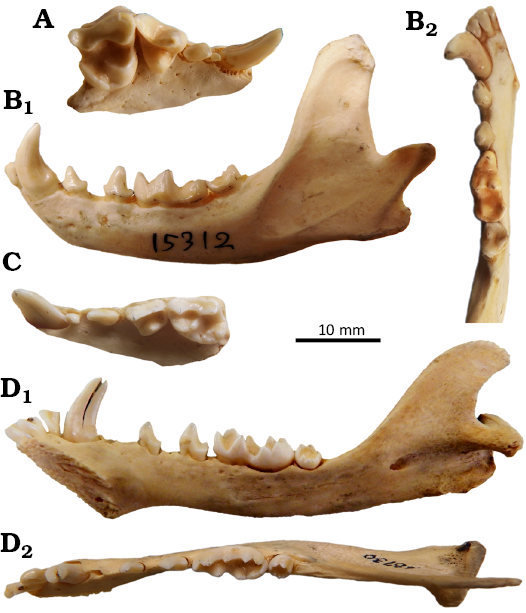
Fig. 8. Dentition of extant Mephitidae. A, B. Mephitis mephitis (Schreber, 1776). A. FMNH 90577, right maxilla with C, P2–4 and M1 in occlusal view. B. FMNH 15132, left hemimandible with i1-i3, c, p3–4, m1–m2 in buccal (B1) and occlusal (B2) views. C, D. Mydaus javanensis (Desmarest, 1820). C. FMNH 68730, left maxilla with C, P2–P4 and M1 in occlusal view. D. FMNH 68730, right hemimandible with i1-i3, p3–4, and m1–2 in lingual (D1) and occlusal (D2) views.
Miomephitis pilgrimi, known exclusively from the German locality of Wintershof-West, shares with modern mephitids the shortening of the premolar row, the subquadrangular M1, the prominent m1 metaconid and the single-rooted m2 (Dehm 1950), as well as similar P4 proportion to the extant Mephitis mephitis (Fig. 6). However, M. pilgrimi still possesses a series of primitive traits compared to later species of the family such as a less developed shelf-like platform distal to the P4 protocone (Fig. 7C), blunt and differentiated cusps instead of shearing crests in the M1 (Fig. 7C–E), a small metaconule in the M1 (Fig. 7C–E), a short m1 talonid (Fig. 7F, G) and lack of accessory rootlets. The rudimentary metaconule is absent in most extant mephitids (Wolsan 1999) but can be seen in certain primitive forms, such as Palaeomeles pachecoi (Vallès-Penedès basin, Spain, MN 7/8–9) (Fig. 7H), Promephitis larteti Gaudry, 1861 (Tuva, Taralyk-Cher Locality, Russia, MN 12–13), Promephitis maeotica Alexejew 1915 (Novoelizavetovka, Ukraine, MN 12) (Araslanov and Lavrov 2024), T. cyamoides (Fig. 4A), and in the extant Mydaus javanensis (Fig. 8C). Miomephitis and Trochotherium share a bunodont M1 with a lack of shearing crests and a shortened m1 talonid. However, M. pilgrimi, has a more primitive M1 characterized by a distinct paracone and metacone that do not occupy most of the occlusal area, and it differs as well in the presence of m1 metaconid and hypoconulid and the lack of accessory rootlets. In contrast, the most similar taxon to Trochotherium is the Late Miocene Neoyunnanotherium, which comprises two species: Neoyunnanotherium lufengense (Section D of the Lufengpithecus Locality, Lufeng, Yunnan, China) and the slightly smaller Neoyunnanotherium yuanmouense (Zong, 1997) (Yuanmou Hominid Fauna, Yuanmou Basin, China) (Zong 1997). Both genera display a highly derived bunodont condition, with hyperdeveloped M1s bearing a large and centrally placed paracone (Fig. 7K), shortened p4s relative to Trocharion and Miomephitis (Fig. 6), a reduced m1 talonid with an elongated distal protoconid wall (Fig. 7L), and accessory rootlets on both M1 and m1 (Qi 2014; Deshmukh and Valenciano 2022). This Chinese carnivoran possesses traits that can be interpreted towards a more durophagous diet than Trochotherium, a more robust mandibular corpus, relatively shorter P4s and m1s and wider lower premolars (Figs. 6, 7L).
As outlined previously, the dental morphology of T. cyamoides and Neoyunnanotherium spp., and to a lesser extent M. pilgrimi, differs significantly from that of crown group mephitids (Fig. 8). In the case of M. pilgrimi, the combination of primitive and derived traits leads us to question whether it is a true member of the family Mephitidae or if it should instead be interpreted as a stem Mephitidae. Its morphology is considerably different from that of subsequently younger mephitids (such as Proputorius, Middle to Late Miocene, MN 5–7/8; see Peigné 2012, Kargopoulos et al. 2022 and references therein), which already exhibit the typical morphology of Mephitidae seen in other Eurasian members of this family from the Middle to Late Miocene (Palaeomeles, Mesomephitis, and Promephitis) (Fig. 9). Neogene mephitids in North America, such as Martinogale Hall, 1930 (late Clarendonian to late Hemphillian, c. Late Miocene) and Buisnictis Hibbard, 1950 (early to middle Blancan, c. Middle to Late Pliocene), also exhibit clear Mephitidae dental characteristics (Wang et al. 2005, 2014). Molecular estimations suggest that Mephitidae first appeared in the early Oligocene c. 28 Ma (e.g., Sato et al. 2009, 2012; Law et al. 2018), meaning there would be a gap of almost 10 myr between their divergence from the other Musteloidea and the appearance of M. pilgrimi in the Early Miocene. Therefore, M. pilgrimi may not be the first crown group member of this family, and its combination of primitive and derived traits suggests that it belonged to a lineage of stem mephitids instead. In fact, certain authors consider the Late Miocene Promephitis to be the first crown Mephitidae genus (Geraads and Spassov 2016; Araslanov and Lavrov 2024). If Miomephitis represents a morphological precursor to Trochotherium and Neoyunnanotherium, as some authors have suggested (Dehm 1950; Heizmann 1973; Deshmukh and Valenciano 2022), then these two genera would also be placed outside of crown Mephitidae.
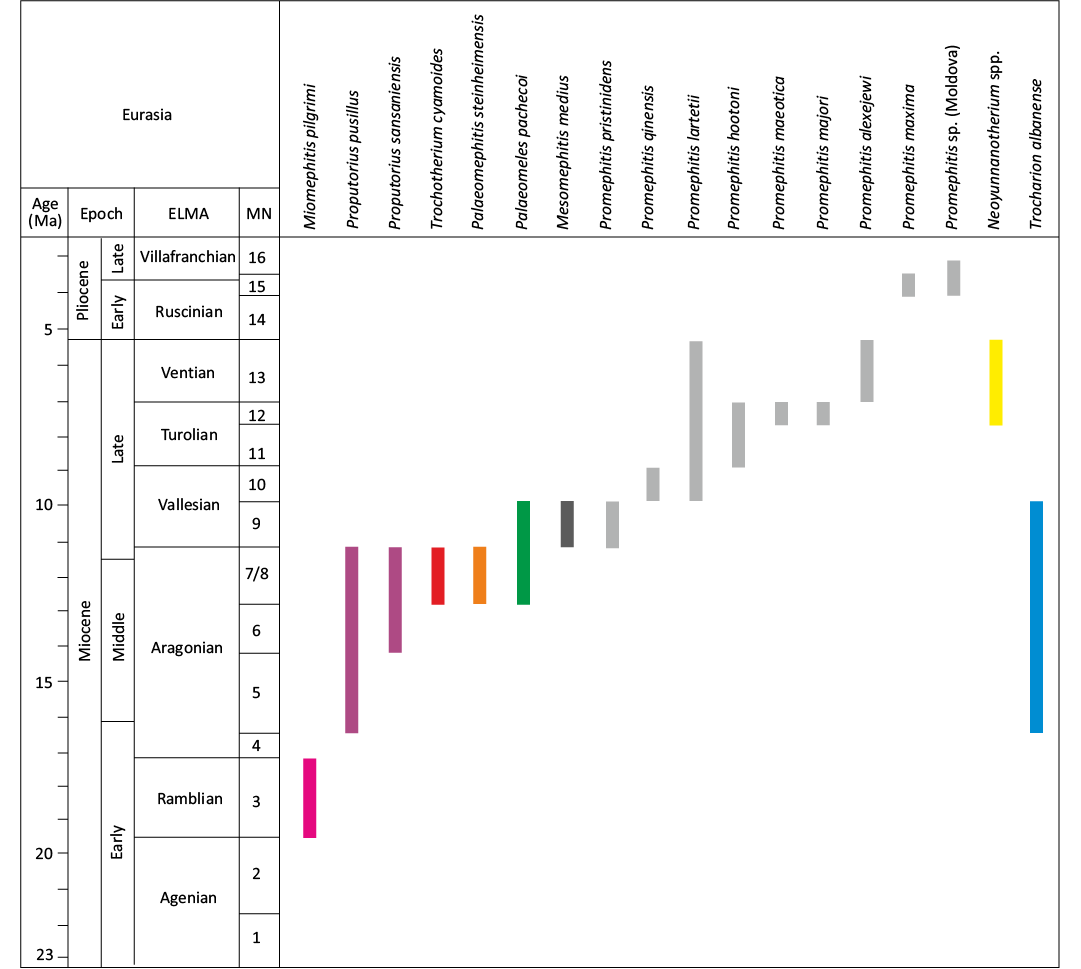
Fig. 9. Chronological ranges of selected crown and stem Mephitidae species from Eurasia, together with the leptarctine mustelid Trocharion albanense. Sources: Dehm (1950), Ginsburg (1961, 1999), Petter (1967), Crusafont Pairó and Golpe Posse (1982), He and Huang (1991), Zong (1997), Morales et al. (1999), Wolsan (1999), Mein and Ginsburg (2002), Wang and Qiu (2004), Koufos (2008), Nagel et al. (2009), Montoya et al. (2011), Peigné (2012), Qi (2014), Geraads and Spassov (2016), Kargopoulos et al. (2022), Jiangzuo et al. (2023), Araslanov and Lavrov (2024), and Araslanov et al. (2026).
Insights into dietary adaptations.—Durophagy can be defined as the feeding mechanism of an animal that consumes hard-shelled prey, including mollusks and crustaceans (Vermeij 1977), but can also be used in reference to animals that feed on bones or hard plant material (e.g., Werdelin 1989; Figueirido et al. 2013). This type of diet requires a specific dental morphology, in which teeth are usually blunt and low-crowned. These dental traits are perfect for producing widespread fractures on hard skeletal elements, as well as dissipating the stress caused by strong occlusal forces (Lucas 2004; Constantino et al. 2011; Crofts 2015; Crofts et al. 2020). Multiple groups of extinct vertebrates with blunt teeth have been inferred as feeding on hard-shelled invertebrates, such as some Paleozoic placoderms and chondrichthyans (Vermeij 1977; Sallan and Coates 2010; Sallan et al. 2011; Salamon et al. 2014), Mesozoic marine reptiles (Vermeij 1977; Massare 1987; Gorzelak et al. 2012; Huang et al. 2020), terrestrial amphisbaenian lizards (Estes and Williams 1984; Martín et al. 2013; Georgalis et al. 2024) and mammals. Several examples of durophagous mammals have been described in Marsupialia (Maga and Beck 2017; Churchill et al. 2025), Eulipotyphla (Ziegler 1999; Furió et al. 2011; Crespo et al. 2018), Chiroptera (Dumont and Herrel 2003), Hominoidea (Berthaume et al. 2010; Constantino et al. 2011) and Carnivora, including hyaenids (Van Valkenburgh 1999; Palmqvist et al. 2011), canids (Werdelin 1989; Tseng and Wang 2011), ursids (Johnson et al. 1988; Figueirido et al. 2010, 2011), ailurids (Johnson et al. 1988), procyonids (Emmons 1990), pinnipeds (Amson and Muizon 2014; Loch et al. 2016), and mustelids (Riedman and Estes 1990; Morales and Pickford 2005; Grohé et al. 2013; Valenciano et al. 2016). Durophagous carnivorans tend to possess shorter, wider and more robust skulls and mandibles, enlarged areas for the insertion of masticatory muscles, and reinforced tooth enamel (Davis 1964; Binder and Van Valkenburgh 2000; Van Valkenburgh 2007; Chai et al. 2009; Figueirido et al. 2013 and references therein). However, there are some differences between durophagous carnivorans based on their diet. For instance, bamboo-feeders like the giant and red pandas possess a condylar process with a higher position relative to the tooth row than bone-cracking carnivores (Figueirido et al. 2013). The bamboo-feeders are adapted to withstand the fatigue that comes with long periods of chewing, while the carnivorans that feed upon bones (hyaenids and Borophaginae canids) exert maximal force during short-duration forceful bites (Figueirido et al. 2013). Extant musteloids who feed on hard-shelled aquatic invertebrates, as the sea otter (Enhydra lutris) and the crab-eating raccoon (Procyon cancrivorus), possess a series of dental traits perfect for cracking the shells of their prey: large P4s and M1s, with multiple blunt and rounded cusps; wide m1s with blunt cuspids; and very thick enamel (Riley 1985; Márquez and Fariña 2003; Constantino et al. 2011; Quintela et al. 2014; Ziscovici et al. 2014; Law et al. 2017; Selig 2023) (Fig. 10).
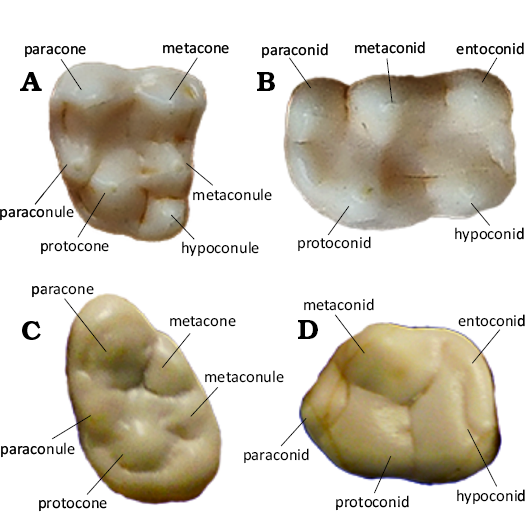
Fig. 10. Upper and lower first molars of extant durophagous musteloids in occlusal view. A, B. Procyon cancrivorus Cuvier, 1798, NRM-A587124. A. Left M1. B. Left m1. C, D. Enhydra lutris (Linnaeus, 1758), USNM 286400. C. Right M1 (mirrored). D. Left m1. Not to scale.
Multiple authors have interpreted T. cyamoides as a durophagous carnivoran (Fraas 1870; Viret 1935; Helbing 1936; Heizmann 1973; Ginsburg 1999; Deshmukh and Valenciano 2022), with a diet primarily based on aquatic shelled invertebrates. This interpretation is supported by its bunodont dentition, characterized by low, rounded cusps, thickened enamel, and a typical flat wear pattern in old specimens. Furthermore, the occlusal wear observed on several M1s and m1s of T. cyamoides suggest that the extremely enlarged and pointed M1 paracone (when unworn) occluded with the distal, elongated wall of the m1 protoconid, forming a crushing surface well suited for breaking invertebrate shells (Fig. 11A, B). This diet would be quite different from that of extant mephitids, who are omnivorous and utilize the crest-like cusps in their M1s to slice their prey (Nowak 1999). However, when compared to the extant durophagous musteloids who feed on aquatic invertebrates such as the sea otter (Enhydra lutris) and the crab-eating raccoon (Procyon cancrivorus) (Fig. 10), T. cyamoides and Neoyunnanotherium spp. differ from them in possessing smaller P4s, an enlarged M1 paracone occupying most of the occlusal surface, and longer m1. Thus, the dental morphology of T. cyamoides and Neoyunnanotherium spp. is unique within the order Carnivora. Instead, it bears a closer resemblance to the upper premolars of certain Cenozoic tetrapods such as Malleodectidae marsupials (Arena et al. 2011; Archer et al. 2016; Churchill et al. 2025), Dimylidae insectivores (van den Hoek Ostende 1995; Furió et al. 2011; Crespo et al. 2018), and amphisbaenian lizards (Georgalis et al. 2024). The M1 of T. cyamoides resembles the P3 of the Middle Miocene Australian marsupial Malleodectes mirabilis Arena et al., 2011, which is hypertrophied, occlusally ovate and lacks distinct cusps or blades (Churchill et al. 2025) (Fig. 11C). The P3 of this marsupial is also similar to the maxillary teeth of snail-eating skink lizards (Arena et al. 2011). Meanwhile, the m1 of T. cyamoides appears to be similar to the p2 of this marsupial (Fig. 11D) and to the elongated, unicuspid teeth present in the Eocene amphisbaenian Terastiodontosaurus marcelosanchezi Georgalis et al., 2024 (Fig. 11E, F). Both Malleodectes mirabilis and Terastiodontosaurus marcelosanchezi have been interpreted as having fed primarily on snails (Arena et al. 2011; Archer et al. 2016; Georgalis et al. 2024; Churchill et al. 2025). The parallel teeth morphology of T. cyamoides to these land-dwelling, snail-eating specialists, as well as the lack of postcranial material that would support a semi-aquatic lifestyle (Qiu and Schmidt-Kittler 1982), leads us to suggest that this carnivoran may have fed primarily on terrestrial gastropods, but we cannot completely rule out a diet based on aquatic invertebrates, such as that seen in the extant herpestid Atilax paludinosus Cuvier, 1829, or the procyonid Procyon cancrivorus (Nowak 1999).
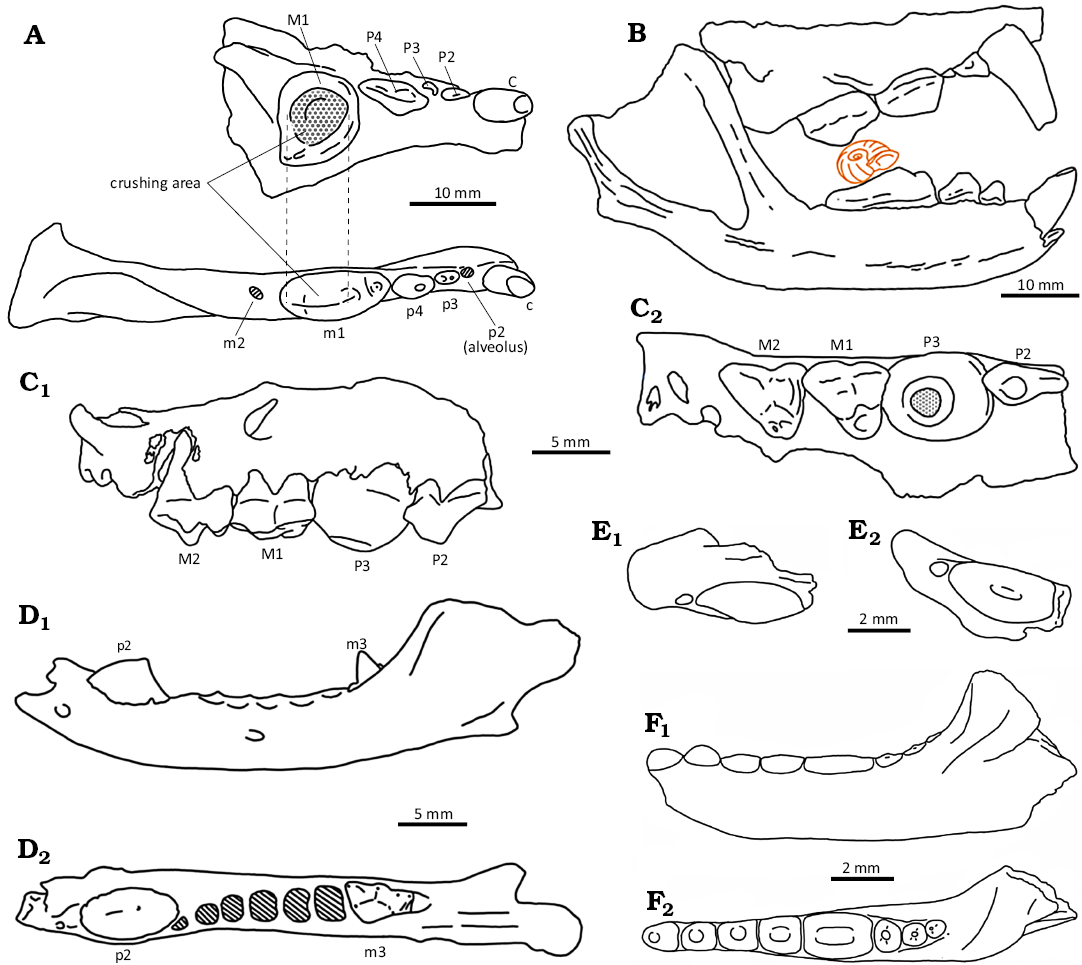
Fig. 11. Examples of small-sized durophagous tetrapods. A, B. Scheme of crushing mechanism in Trochotherium cyamoides Fraas, 1870. A. Crushing area formed between the M1 paracone and the m1 protoconid distal wall. B. Representation of T. cyamoides feeding on a Gyraulus snail (traced from Rasser 2014) from Steinheim am Albuch. C, D. Malleodectes mirabilis Arena et al., 2011 (modified from Churchill et al. 2025). C. QM F61725, left maxilla in buccal (C1) and occlusal (C2) views. D. QM F61727, left hemimandible in buccal (D1) and occlusal (D2) views. E, F. Terastiodontosaurus marcelosanchezi Georgalis et al., 2024 (modified from Georgalis et al. 2024). E. ONM CBI-1-667, right maxillary tooth in buccal (E1) and occlusal (E2) views. F. ONM CBI-1-646, left dentary in buccal (F1) and occlusal (F2) views.
Conclusions
The description of new fossils of Trochotherium cyamoides from La Grive-Saint-Alban and Kleineisenbach, alongside the re-evaluation of all the known material of this species, contributes to a better understanding of this enigmatic carnivoran and expand its geographical range. We observed variability in the position of the P4 protocone, consisting of a mesial position of this cusp in specimens from Anwil and a more central position in those from Steinheim am Albuch. Additionally, the width of the m1 talonid varies in the populations from La Grive-Saint-Alban and Steinheim am Albuch. The Steinheim am Albuch population, which is the most well-documented one, also exhibits the greatest variability in size. All these differences are interpreted as intraspecific variation, primarily reflecting phenotypic plasticity.
Based on its dental characteristics, we consider T. cyamoides to be a stem Mephitidae, as it displays a combination of diagnostic traits of this family (e.g., the distally placed protocone of the P4, larger M1 than P4, single-rooted m2) alongside derived traits (e.g., bunodont dentition, enlarged cusp in the M1 instead of shearing crests, shortened m1 talonid, and absence of metaconid and entoconid) that do not appear in other extinct and extant mephitids. Miomephitis pilgrimi and Neoyunnanotherium spp. should also be considered stem Mephitidae due to their similarities with T. cyamoides. The peculiar morphology of the dentition of T. cyamoides, which resembles that of certain snail-eating extinct marsupials and lizards, suggests that this carnivoran may have fed on terrestrial gastropods by occluding the hyperdeveloped M1 paracone with the distal wall of the m1 protoconid.
Acknowledgements
We would like to thank the following curators and collection managers for granting access to the material from their respective institutions: Didier Berthet (MdC), Emmanuel Robert (UCBL-FSL), Gertrud Rössner (SNSB-BSPG), and Ursula Göhlich (NHMW). We also want to thank Emmanuel Robert, for providing the catalogue numbers of the specimens of T. cyamoides from La Grive-Saint-Alban housed at his institution; Eli Amson (SMNS), for clearing our doubts about the SMNS-P-16193 specimen and confirming the catalogue number of the SMNS-P-5042 specimen of T. cyamoides from Steinheim am Albuch; and Gertrud Rössner, for granting permission to figure and describe the material of T. cyamoides housed at her institution, as well as providing images of the SNSB-BSPG-1938 V 21 specimen of M. pilgrimi. Lastly, we would like to thank Pierre Mein (UCBL-FSL) for collecting the fossils of T. cyamoides from La Grive-Saint-Alban housed at UCBL. This study was supported by the Research Group UCM910607, and the projects PID2023-151089NB-I00 and PID2022-138275NB-I00 funded by MCIU /AEI /10.13039/501100011033/ FEDER, UE. DSH is funded by a predoctoral fellowship CT22/25 from the Complutense University of Madrid. We are indebted to the Editorial Team of Acta Palaeontologica Polonica and the reviewers Xiaoming Wang (LACMNH) and Jack Tseng (UC) for their helpful comments and suggestions, which have improved the original manuscript.
Editor: Eli Amson
References
Abramov, A.V. and Puzachenko, A.Y. 2005. Sexual dimorphism of craniological characters in Eurasian badgers, Meles spp. (Carnivora, Mustelidae). Zoologischer Anzeiger-A Journal of Comparative Zoology 244: 11–29. Crossref
Alexejew, A.K. 1915. Fauna pozvonočnyh derevni Novo-Elizavetovki. 453 pp. Tipografâ Tehnik, Odessa.
Amson, E. and Muizon, C. de 2014. A new durophagous phocid (Mammalia: Carnivora) from the late Neogene of Peru and considerations on monachine seals phylogeny. Journal of Systematic Palaeontology 12: 523–548. Crossref
Anderson, E. 1989. The phylogeny of mustelids and the systematics of ferrets. In: U.S. Seal, E.T. Thorne, M.A. Bogan, and S.H. Anderson (eds.), Conservation Biology and the Black-Footed Ferret, 10–20. Yale University Press, New Haven. Crossref
Araslanov, I.F. and Lavrov, A.V. 2024. Promephitis lartetii Gaudry, 1861 (Carnivora: Mephitidae) from the Late Miocene of Tuva (Taralyk-Cher Locality). Paleontological Journal 58: 232–244. Crossref
Araslanov, I.F., Lavrov, A.V., Baryshnikov, G.F., and Averianov, A.O. 2026. The youngest known European Promephitis (Carnivora: Mephitidae): a new discovery from the Early Pliocene of Moldova. Historical Biology 38: 266–271. Crossref
Archer, M., Hand, S.J., Black, K.H., Beck, R.M.D., Arena, D.A., Wilson, L.A.B., Kealy, S., and Hung, T.-T. 2016. A new family of bizarre durophagous carnivorous marsupials from Miocene deposits in the Riversleigh World Heritage Area, northwestern Queensland. Scientific Reports 6 (1): 26911. Crossref
Arena, D.A., Archer, M., Godthelp, H., Hand, S.J., and Hocknull, S. 2011. Hammer-toothed ‘marsupial skinks’ from the Australian Cenozoic. Proceedings of the Royal Society B: Biological Sciences 278: 3529–3533. Crossref
Arranz, S.G., Casanovas-Vilar, I., Žliobaitė, I., Abella, J., Angelone, C., Azanza, B., Bernor, R., Cirilli, O., DeMiguel, D., Furió, M., Pandolfi, L., Robles, J.M., Sánchez, I.M., Van Den Hoek Ostende, L.W., and Alba, D.M. 2023. Paleoenvironmental inferences on the Late Miocene hominoid-bearing site of Can Llobateres (NE Iberian Peninsula): An ecometric approach based on functional dental traits. Journal of Human Evolution 185: 103441. Crossref
Baskin, J.A. 1998. Mustelidae. In: C.M. Janis, K.M. Scott, and L.L. Jacobs (eds.), Evolution of Tertiary Mammals of North America. Volume 1: Terrestrial Carnivores, Ungulates, and Ungulate-like Mammals, 152–173. Cambridge University Press, Cambridge. Crossref
Berthaume, M., Grosse, I.R., Patel, N.D., Strait, D.S., Wood, S., and Richmond, B.G. 2010. The effect of early hominin occlusal morphology on the fracturing of hard food items. The Anatomical Record 293: 594–606. Crossref
Binder, W.J. and Van Valkenburgh, B. 2000. Development of bite strength and feeding behaviour in juvenile spotted hyenas (Crocuta crocuta). Journal of Zoology 252: 273–283. Crossref
Black, C.C. 1966. Tertiary Sciuridae (Mammalia: Rodentia) from Bavaria. Mitteilungen der Bayerischen Staatssammlung für Paläontologie und historische Geologie 6: 51–63.
Bonaparte, C.L. 1838. Synopsis vertebratorum systematis. Nuovi Annali delle Scienze Naturali 2: 105–133.
Bonaparte, C.L. 1845. Catalogo metodico dei mammiferi europei. 36 pp. Coi Tipi di Luigi di Giacomo Pirola, Milano. Crossref
Bonis, L. de 2005. Carnivora (Mammalia) from the late Miocene of Akkaşdağı, Turkey. Geodiversitas 27: 567-589.
Bowdich, T.E. 1821. An Analysis of the Natural Classifications of Mammalia, For the Use of Students and Travellers. 180 pp. J. Smith, Paris.
Bruijn, H. de, Daams, R., Daxner-Höck, G., Fahlbusch, V., Ginsburg, L., Mein, P., Morales, J., Heinzmann, E., Mayhew, D.F., Van Der Meulen, A.J., Schmidt-Kittler, N., and Antunes, M.T. 1992. Report of the RCMNS working group on fossil mammals, Reisensburg 1990. Newsletters on Stratigraphy 26 (2–3): 65–118. Crossref
Bruijn, H. de, Fahlbusch, V., Saraç, G., and Ünay, E. 1993. Early Miocene rodent faunas from the eastern Mediterranean area: Part III. The genera Deperetomys and Cricetodon with a discussion of the evolutionary history and the Cricetodontini. Proceedings van de Koninklijke Nederlandse Akademie van Wetenschappen, Series B 96: 151–216.
Bryant, H.N., Russell, A.P., and Fitch, W.D. 1993. Phylogenetic relationships within the extant Mustelidae (Carnivora): appraisal of the cladistic status of the Simpsonian subfamilies. Zoological Journal of the Linnean Society 108: 301–334. Crossref
Chai, H., Lee, J.J.-W., Constantino, P.J., Lucas, P.W., and Lawn, B.R. 2009. Remarkable resilience of teeth. Proceedings of the National Academy of Sciences 106: 7289–7293. Crossref
Churchill, T.J., Archer, M., and Hand, S.J. 2025. A new genus and two new species of malleodectid (Marsupialia, Malleodectidae) from the Middle and Late Miocene deposits of the Riversleigh World Heritage Area, northwestern Queensland. Journal of Mammalian Evolution 32 (2): 16. Crossref
Constantino, P.J., Lee, J.J.-W., Morris, D., Lucas, P.W., Hartstone-Rose, A., Lee, W.-K., Dominy, N.J., Cunningham, A., Wagner, M., and Lawn, B.R. 2011. Adaptation to hard-object feeding in sea otters and hominins. Journal of Human Evolution 61: 89–96. Crossref
Crespo, V.D., Furió, M., Ruiz-Sánchez, F.J., and Montoya, P. 2018. A new species of Plesiodimylus (Dimylidae, Eulipotyphla, Mammalia) from the Early Miocene of Spain. Historical Biology 30: 360–371. Crossref
Crofts, S.B. 2015. The Functional Morphology of Hard-prey Crushing Teeth. 86 pp. University of Washington, Seattle.
Crofts, S.B., Smith, S.M. and Anderson, P.S.L. 2020. Beyond description: the many facets of dental biomechanics. Integrative and Comparative Biology 60: 594–607. Crossref
Crusafont Pairó, M. and Golpe Posse, J.M. 1982. Hallazgo de Palaeomelles pachecoi Vill. et Crus., 1943, en Castell de Barberà (Vallés-Penedés). Acta Geológica Hispánica 17: 27–37.
Cuvier, F. 1821. Le télagon. In: E. Geoffroy Saint-Hilaire and F. Cuvier (eds.), Histoire naturelle des mammifères : avec des figures originales, coloriées, dessinées d’aprèsdes animaux vivans, Vol. 27, 2, pl. 159. Blaise, Paris.
Cuvier, G. 1798. Tableau élémentaire de l’histoire naturelle des animaux. 774 pp. Baudouin, Paris. Crossref
Cuvier, G. 1829. Le règne animal, distribué d’après son organisation, pour servir de base à l’histoire naturelle des animaux et d’introduction à l’anatomie comparée. Nouvelle édition, revue et augmentée. Tome I. 584 pp. Chez Deterville et Chez Crochard, Paris. Crossref
Davis, D.D. 1964. The giant panda: a morphological study of evolutionary mechanisms. Fieldiana Zoology Memoirs 3: 1–339 Crossref
Dehm, R. 1950. Die Raubtiere aus dem Mittel-Miocän (Burdigalium) von Wintershof-West bei Eichstätt in Bayern. Abhandlungen der Bayerische Akademie der Wissenschaften 58: 1–14.
Depéret, C. 1892. La faune de mammifères miocènes de la Grive-Saint-Alban (Isère) et de quelques autres localités du bassin du Rhône. Documents nouveaux et révision générale. Archives du Muséum d’histoire naturelle de Lyon 5 (1): 1–15. Crossref
Deshmukh, U.B. and Valenciano, A. 2022. Neoyunnanotherium nom. nov., a replacement name for the genus Yunnanotherium Qi, 2014 (Carnivora, Mephitidae) non Han, 1986 (Tragulidae). Zootaxa 5222: 298–300. Crossref
Desmarest, A.G. 1820. Mammalogie ou description des espèces de mammifères. 553 pp. Veuve Agasse, Paris. Crossref
Dragoo, J.W. 2009. Family Mephitidae (skunks). In: D.E.Wilson and R.A.Mittermeier (eds.), Handbook of the Mammals of the World. Vol. 1: Carnivores, 532–563. Lynx Edicions, Barcelona.
Dragoo, J.W. and Honeycutt, R.L. 1997. Systematics of mustelid-like carnivores. Journal of Mammalogy 78: 426–443. Crossref
Dumont, E.R. and Herrel, A. 2003. The effects of gape angle and bite point on bite force in bats. Journal of Experimental Biology 206: 2117–2123. Crossref
Emmons, L.H. 1990. Neotropical Rainforest Mammals: A Field Guide. 410 pp. University of Chicago Press, Chicago.
Engesser, B. 1972. Die obermiozäne Säugetierfauna von Anwil (Baselland). Tätigkeitsbericht der Naturforschenden Gesellschaft Baselland 28: 37–363.
Estes, R. and Williams, E.E. 1984. Ontogenetic variation in the molariform teeth of lizards. Journal of Vertebrate Paleontology 4: 96–107. Crossref
Fahlbusch, V. 1975. Die Eomyiden (Rodentia, Mammalia) der Oberen Süsswasser-Molasse Bayerns. Mitteilungen der bayerischen Staatsammlung für Paläontologie und historische Geologie 15: 63–90.
Figueirido, B., Palmqvist, P., Pérez-Claros, J.A., and Dong, W. 2011. Cranial shape transformation in the evolution of the giant panda (Ailuropoda melanoleuca). Naturwissenschaften 98: 107–116. Crossref
Figueirido, B., Serrano‐Alarcón, F.J., Slater, G.J., and Palmqvist, P. 2010. Shape at the cross‐roads: homoplasy and history in the evolution of the carnivoran skull towards herbivory. Journal of Evolutionary Biology 23: 2579–2594. Crossref
Figueirido, B., Tseng, Z.J., and Martín-Serra, A. 2013. Skull shape evolution in durophagous carnivorans. Evolution 67: 1975–1993. Crossref
Filhol, H. 1883. Note sur quelques Mammifères fossiles de l’époque miocène. Archives du Muséum d’histoire naturelle de Lyon 3 (1): 1–99. Crossref
Filhol, H. 1890. Étude sur les mammifères de Sansan. Bibliothèque des Hautes Études, Section des Sciences Naturelles 37: 1–319.
Finarelli, J.A. 2008. A total evidence phylogeny of the Arctoidea (Carnivora: Mammalia): relationships among basal taxa. Journal of Mammalian Evolution 15: 231–259. Crossref
Fischer, G. 1817. Adversaria Zoologica, fasciculus primus. Mémoires de la Société Impériale des Naturalistes de Moscou 5: 357–446.
Flynn, J.J., Finarelli, J.A., Zehr, S., Hsu, J., and Nedbal, M.A. 2005. Molecular phylogeny of the Carnivora (Mammalia): assessing the impact of increased sampling on resolving enigmatic relationships. Systematic Biology 54: 317–337. Crossref
Forsyth Major, C.I. 1903. New Carnivora from the Middle Miocene of La Grive-Saint-Alban, Isère, France. Geological Magazine 10: 534–538. Crossref
Fraas, O. 1870. Die Fauna von Steinheim: mit Rücksicht auf die miocenen Säugethier-und Vogelreste des Steinheimer Beckens. Jahreshefte des Vereins fur vaterlandische Naturkunde in Wurttemberg 26: 145–306. Crossref
Fraas, O. 1885. Beiträge zur Fauna von Steinheim. Jahreshefte des Vereins für Vaterländische Naturkunde in Württemberg: Zugleich Jahrbuch des Staatlichen Museums für Naturkunde in Stuttgart 41: 313–326.
Fulton, T.L. and Strobeck, C. 2007. Novel phylogeny of the raccoon family (Procyonidae: Carnivora) based on nuclear and mitochondrial DNA evidence. Molecular Phylogenetics and Evolution 43: 1171–1177. Crossref
Fulwood, E. and Wallace, S. 2015. Evidence for unusual size dimorphism in a fossil ailurid. Palaeontologia Electronica 18 (3): 45A. Crossref
Furió, M., Casanovas-Vilar, I., and Van Den Hoek Ostende, L.W. 2011. Predictable structure of Miocene insectivore (Lipotyphla) faunas in Western Europe along a latitudinal gradient. Palaeogeography, Palaeoclimatology, Palaeoecology 304: 219–229. Crossref
Gaudry, A. 1861. Résultats des fouilles entreprises en Grèce sous les auspices de l’Académie. Compte Rendus de l’Académie des Sciences 52: 722–724.
Gazin, C.L. 1936. A new mustelid carnivore from the Neogene beds of northwestern Nebraska. Journal of Washington Academy of Science 26: 199–207.
Georgalis, G.L., Smith, K.T., Marivaux, L., Herrel, A., Essid, E.M., Khayati Ammar, H., Marzougui, W., Temani, R., and Tabuce, R. 2024. The world’s largest worm lizard: a new giant trogonophid (Squamata: Amphisbaenia) with extreme dental adaptations from the Eocene of Chambi, Tunisia. Zoological Journal of the Linnean Society 202: zlae133. Crossref
Geraads, D. and Spassov, N. 2016. Musteloid carnivores from the upper Miocene of South-Western Bulgaria, and the phylogeny of the Mephitidae. Geodiversitas 38: 543–558. Crossref
Ginsburg, L. 1961. La faune des carnivores miocènes de Sansan (Gers). Mémoires du Muséum national d’Histoire naturelle. Nouvelle Série, Série C, Sciences de la Terre 9: 1–190.
Ginsburg, L. 1999. Order Carnivora. In: G.E. Rössner and K. Heissig (eds.), The Miocene Land Mammals of Europe, 109–148. Verlag Dr. Friedrich Pfeil, München.
Gittleman, J.L. and Van Valkenburgh, B. 1997. Sexual dimorphism in the canines and skulls of carnivores: effects of size, phylogeny, and behavioural ecology. Journal of Zoology 242: 97–117. Crossref
Gorzelak, P., Salamon, M.A., and Baumiller, T.K. 2012. Predator-induced macroevolutionary trends in Mesozoic crinoids. Proceedings of the National Academy of Sciences 109: 7004–7007. Crossref
Grohé, C., De Bonis, L., Chaimanee, Y., Blondel, C., and Jaeger, J. 2013. The oldest Asian Sivaonyx (Lutrinae, Mustelidae): a contribution to the evolutionary history of bunodont. Palaeontologia Electronica 16 (3): 30A. Crossref
Hall, E.R. 1930. Three new genera of Mustelidae from the Later Tertiary of North America. Journal of Mammalogy 11: 146–155. Crossref
Hassanin, A., Veron, G., Ropiquet, A., Jansen Van Vuuren, B., Lécu, A., Goodman, S.M., Haider, J., and Nguyen, T.T. 2021. Evolutionary history of Carnivora (Mammalia, Laurasiatheria) inferred from mitochondrial genomes. PLOS ONE 16 (2): e0240770. Crossref
He, J. and Huang, W.-B. 1991. A new species of Promephitis from the Pliocene of Tongshan County, Jiangsu Province. Vertebrata Palasiatica 29: 303–313.
Heizmann, E.P.J. 1973. Die Carnivoren des Steinheimer Beckens. B. Ursidae, Felidae, Viverridae sowie Ergänzungen und Nachträge zu den Mustelidae. Palaeontographica Supplement-Band 5: 1–95.
Helbing, H. 1936. Die Carnivoren des Steinheimer Beckens. A. Mustelidae. Palaeontographica Supplement-Band 8 (5): 1–56.
Hibbard, C.W. 1950. Mammals of the Rexroad Formation from Fox Canyon, Kansas. Museum of Paleontology, The University of Michigan 8 (6): 113–192.
Huang, J., Motani, R., Jiang, D., Ren, X., Tintori, A., Rieppel, O., Zhou, M., Hu, Y., and Zhang, R. 2020. Repeated evolution of durophagy during ichthyosaur radiation after mass extinction indicated by hidden dentition. Scientific Reports 10 (1): 7798. Crossref
Jäger, G. 1839. Über die fossilen Säugetiere, welche in Württemberg in verschiedenen Formationen aufgefunden worden sind, nebst geognostischen Bemerkungen über diese Formationen. 214 pp. Erhard, Stuttgart.
Jiangzuo, Q., Wang, S., and Deng, T. 2023. Chronological framework and palaeoecology of Carnivora from the Linxia Basin, China. Palaeogeography, Palaeoclimatology, Palaeoecology 615: 111463. Crossref
Johnson, K.G., Schaller, G.B., and Jinchu, H. 1988. Comparative Behavior of Red and Giant Pandas in the Wolong Reserve, China. Journal of Mammalogy 69: 552–564. Crossref
Kargopoulos, N., Valenciano, A., Abella, J., Kampouridis, P., Lechner, T., and Böhme, M. 2022. The exceptionally high diversity of small carnivorans from the Late Miocene hominid locality of Hammerschmiede (Bavaria, Germany). PLOS ONE 17 (7): e0268968.
Klaus, S. and Gross, M. 2010. Synopsis of the fossil freshwater crabs of Europe (Brachyura: Potamoidea: Potamidae). Neues Jahrbuch für Geologie und Paläontologie-Abhandlungen 256: 39–59. Crossref
Koepfli, K.-P., Dragoo, J.W., and Wang, X. 2018. The evolutionary history and molecular systematics of the Musteloidea. In: D.W. Macdonald, C. Newman, and L.A. Harrington (eds.), Biology and Conservation of Musteloids, 76–91. Oxford University Press, Oxford. Crossref
Korablev, M.P., Korablev, N.P., and Korablev, P.N. 2013. Population aspects of sexual dimorphism in Mustelidae from the example of four species (Mustela lutreola, Neovison vison, Mustela putorius, and Martes martes). Biology Bulletin 40: 61–69. Crossref
Koufos, G.D. 2008. Carnivores from the early/middle Miocene locality of Antonios (Chalkidiki, Macedonia, Greece). Geobios 41: 365–380. Crossref
Law, C.J., Baliga, V.B., Tinker, M.T., and Mehta, R.S. 2017. Asynchrony in craniomandibular development and growth in Enhydra lutris nereis (Carnivora: Mustelidae): are southern sea otters born to bite? Biological Journal of the Linnean Society 121: 420–438. Crossref
Law, C.J., Slater, G.J., and Mehta, R.S. 2018. Lineage diversity and size disparity in Musteloidea: testing patterns of adaptive radiation using molecular and fossil-based methods. Systematic Biology 67: 127–144. Crossref
Linnaeus, C. 1758. Systema naturae per regna tria naturae, secundum classes, ordines, genera, species, cum characteribus, differentiis, synonymis, locis. Vol. 1. 824 pp. Laurentii Salvii, Stockholm. Crossref
Loch, C., Boessenecker, R.W., Churchill, M., and Kieser, J. 2016. Enamel ultrastructure of fossil and modern pinnipeds: evaluating hypotheses of feeding adaptations in the extinct walrus Pelagiarctos. The Science of Nature 103 (5–6): 1–8. Crossref
López-Antoñanzas, R. and Mein, P. 2011. First detailed description of Hispanomys decedens (Rodentia) from the Middle Miocene of La Grive-Saint Alban (France). Swiss Journal of Geosciences 104 (2): 345–353. Crossref
Lucas, P.W. 2004. Dental Functional Morphology: How Teeth Work. 372 pp. Cambridge University Press, Cambridge. Crossref
Machado, G.A., Azevedo, F.C., Freitas-Junior, M.C., Lima, C.F.M., Cavalcanti, G.N., Cunha, A.A., Facure, K.G., and Lemos, F.G. 2024. Size does not matter: natural history and sexual dimorphism of the striped hog-nosed skunk (Conepatus amazonicus) in Central Brazil. Mammal Research 69: 257–270. Crossref
Maga, A.M. and Beck, R.M.D. 2017. Skeleton of an unusual, cat-sized marsupial relative (Metatheria: Marsupialiformes) from the middle Eocene (Lutetian: 44–43 million years ago) of Turkey. PLOS ONE 12 (8): e0181712. Crossref
Márquez, A. and Fariña, R.A. 2003. Dental morphology and diet in canids and procyonids from Uruguay. Mammalia 67 (4): 567–574. Crossref
Martín, J., Ortega, J., López, P., Pérez‐Cembranos, A., and Pérez‐Mellado, V. 2013. Fossorial life does not constrain diet selection in the amphisbaenian Trogonophis wiegmanni. Journal of Zoology 291: 226–233. Crossref
Massare, J.A. 1987. Tooth morphology and prey preference of Mesozoic marine reptiles. Journal of Vertebrate Paleontology 7: 121–137. Crossref
Mein, P. 1958. Les mammifères de la faune sidérolithique de Vieux-Collonges. Nouvelles Archives du Muséum d’Historie Naturelle de Lyon 5: 1–122. Crossref
Mein, P. and Ginsburg, L. 2002. Sur l’âge relatif des différents dépôts karstiques miocènes de La Grive-Saint-Alban (Isère). Cahiers scientifiques du Muséum d’histoire naturelle de Lyon-Centre de conservation et d’étude des collections 5 (2): 7–47. Crossref
Montoya, P., Morales, J., and Abella, J. 2011. Musteloidea (Carnivora, Mammalia) del Mioceno Superior de Venta del Moro (Valencia, España). Estudios Geológicos 67 (2): 193. Crossref
Morales, J. and Pickford, M. 2005. Giant bunodont Lutrinae from the Mio-Pliocene of Kenya and Uganda. Estudios Geológicos 61 (3–6): 233–246. Crossref
Morales, J., Nieto, M., Kohler, M., and Moyà-Solà, S. 1999. Large mammals from the Vallesian of Spain. In: J. Agusti, L. Rook, and P. Andrews (eds.), The Evolution of Neogene Terrestrial Ecosystems in Europe, 113–126. Cambridge University Press, Cambridge. Crossref
Muizon, C.D. 1982. Les relations phylogénétiques des Lutrinae (Mustelidae, Mammalia). Geobios 15: 259–277. Crossref
Nagel, D., Stefen, C., and Morlo, M. 2009. The carnivoran community from the Miocene of Sandelzhausen (Germany). Paläontologische Zeitschrift 83: 151–174. Crossref
Nowak, R.M. 1999. Walker’s Mammals of the World. Vol. 1. 926 pp. Johns Hopkins University Press, London.
Palmqvist, P., Martínez-Navarro, B., Pérez-Claros, J.A., Torregrosa, V., Figueirido, B., Jiménez-Arenas, J.M., Patrocinio Espigares, M., Ros-Montoya, S., and De Renzi, M. 2011. The giant hyena Pachycrocuta brevirostris: Modelling the bone-cracking behavior of an extinct carnivore. Quaternary International 243 (1): 61–79. Crossref
Pavia, M. and Mourer-Chauviré, C. 2011. Redescription of Tyto sanctialbani Lydekker, 1893 (Aves, Strigiformes), from its type locality of La Grive-Saint-Alban (middle Miocene, France). Journal of Vertebrate Paleontology 31: 1093–1101. Crossref
Peigné, S. 2012. Les Carnivora de Sansan. In: S. Peigné and S. Sen (eds.), Mammifères de Sansan, 559–660. Mémoires du Muséum national d’Histoire naturelle, Paris.
Petter, G. 1963. Contribution à l’étude des mustélidés des bassins Néogènes du Vallès-Pénédès et de Calatayud-Teruel (Espagne orientale). Mémoires de la Société géologique de France 42 (98): 1–44.
Petter, G. 1967. Mustélidés nouveaux du Vallésien de Catalogne. Annales de Paléontologie 53: 93–113.
Pilgrim, G.E. 1932. The genera Trochictis, Enhydrictis, and Trocharion, with remarks on the taxonomy of the Mustelidae. Proceedings of the Zoological Society of London 102: 845–867. Crossref
Pilgrim, G.E. 1933. A fossil skunk from Samos. American Museum Novitates 663: 1–15.
Prieto, J. 2007. Kleinsäuger-Biostratigraphie und Paläoökologie des höheren Mittelmiozäns (MN 8) Bayerns. 213 pp. Ludwig-Maximilians-Universität, München.
Prieto, J. 2010. The Middle Miocene mole Desmanodon crocheti sp. nov. (Talpidae, Mammalia): the last representative of the genus in the North Alpine foreland basin. Paläontologische Zeitschrift 84: 217–225. Crossref
Prieto, J. 2012. The genus Eomyops Engesser, 1979 (Rodentia, Eomyidae) from the youngest deposits of the German part of the North Alpine Foreland Basin. Swiss Journal of Palaeontology 131: 95–106. Crossref
Prieto, J., Vasilyan, D., Gross, M., Böhme, M., Hassler, A., and Morales, J. 2022. Die miozäne Raubtierfauna von Schönweg-”Brüchl” (Österreich, Kärnten): II. Eine Übersicht. Carinthia I: Mittheilungen des Geschichtsvereins für Kärnten 212/132: 163–174.
Qi, G. 2014. Melinae fossils from the Lufengpithecus Locality, Yunnan. Acta Anthropologica Sinica 33: 389–400.
Qiu, Z. and Schmidt-Kittler, N. 1982. On the phylogeny and zoogeography of the leptarctines (Carnivora, Mammalia). Paläontologische Zeitschrift 56: 131–145. Crossref
Quintela, F.M., Iob, G., and Artioli, L.G.S. 2014. Diet of Procyon cancrivorus (Carnivora, Procyonidae) in restinga and estuarine environments of southern Brazil. Iheringia. Série Zoologia 104: 143–149. Crossref
Rasser, M.W. 2014. Evolution in isolation: the Gyraulus species flock from Miocene Lake Steinheim revisited. Hydrobiologia 739: 7–24. Crossref
Riedman, M.L. and Estes, J.A. 1990. The sea otter (Enhydra lutris): behavior, ecology, and natural history. United States Fish and Wildlife Service, Biological Report 90 (14): 1–126.
Riley, M.A. 1985. An analysis of masticatory form and function in three mustelids (Martes americana, Lutra canadensis, Enhydra lutris). Journal of Mammalogy 66: 519–528. Crossref
Robles, J.M. 2014. Miocene Carnivorans from the Vallès-Penedès Basin (NE Iberian Peninsula). 438 pp. Universitat Autònoma de Barcelona, Barcelona.
Robles, J.M., Alba, D.M., Moyà-Solà, S., Casanovas-Vilar, I., Galindo, J., Rotgers, C., Almécija, S., and Carmona, R. 2010. New craniodental remains of Trocharion albanense Major, 1903 (Carnivora, Mustelidae), from the Vallès-Penedès Basin (middle to late Miocene, Barcelona, Spain). Journal of Vertebrate Paleontology 30: 547–562. Crossref
Sabol, M. 2000. Neogene carnivores of Slovakia. Slovak Geological Magazine 6: 124–126.
Salamon, M.A., Gorzelak, P., Niedźwiedzki, R., Trzęsiok, D., and Baumiller, T.K. 2014. Trends in shell fragmentation as evidence of mid-Paleozoic changes in marine predation. Paleobiology 40: 14–23. Crossref
Sallan, L.C. and Coates, M.I. 2010. End-Devonian extinction and a bottleneck in the early evolution of modern jawed vertebrates. Proceedings of the National Academy of Sciences 107: 10131–10135. Crossref
Sallan, L.C., Kammer, T.W., Ausich, W.I., and Cook, L.A. 2011. Persistent predator–prey dynamics revealed by mass extinction. Proceedings of the National Academy of Sciences 108: 8335–8338. Crossref
Sato, J.J., Hosoda, T., Wolsan, M., and Suzuki, H. 2004. Molecular phylogeny of arctoids (Mammalia: Carnivora) with emphasis on phylogenetic and taxonomic positions of the ferret-badgers and skunks. Zoological Science 21: 111–118. Crossref
Sato, J.J., Wolsan, M., Minami, S., Hosoda, T., Sinaga, M.H., Hiyama, K., Yamaguchi, Y., and Suzuki, H. 2009. Deciphering and dating the red panda’s ancestry and early adaptive radiation of Musteloidea. Molecular Phylogenetics and Evolution 53: 907–922. Crossref
Sato, J.J., Wolsan, M., Prevosti, F.J., D’Elía, G., Begg, C., Begg, K., Hosoda, T., Campbell, K.L., and Suzuki, H. 2012. Evolutionary and biogeographic history of weasel-like carnivorans (Musteloidea). Molecular Phylogenetics and Evolution 63: 745–757. Crossref
Schmidt-Kittler, N. 1981. Zur Stammesgeschichte der marderverwandten Raubtiergruppen (Musteloidea, Carnivora). Eclogae Geologicae Helvetica 74: 753–801.
Schreber, J.C.D. 1776. Die Säugthiere in Abbildungen nach der Natur, mit Beschreibungen. 614 pp. Expedition des Schreber’schen säugthier- und des Esper’schen Schmetterlingswerkes, Erlangen.
Selig, K.R. 2023. Form, function, and tissue proportions of the mustelid carnassial molar. Mammal Research 68: 637–646. Crossref
Smith, J.B. and Dodson, P. 2003. A proposal for a standard terminology of anatomical notation and orientation in fossil vertebrate dentitions. Journal of Vertebrate Paleontology 23: 1–12. Crossref
Tseng, Z.J. 2025. Newly described specimens of leptarctine mustelids expand their geographic range in the western United States. PaleoBios 42 (6): 1–10. Crossref
Tseng, Z.J. and Wang, X. 2011. Do convergent ecomorphs evolve through convergent morphological pathways? Cranial shape evolution in fossil hyaenids and borophagine canids (Carnivora, Mammalia). Paleobiology 37: 470–489. Crossref
Valenciano, A., Baskin, J.A., Abella, J., Pérez-Ramos, A., Álvarez-Sierra, M.Á., Morales, J., and Hartstone-Rose, A. 2016. Megalictis, the bone-crushing giant mustelid (Carnivora, Mustelidae, Oligobuninae) from the Early Miocene of North America. PLOS ONE 11 (4): e0152430. Crossref
Van den Hoek Ostende, L. 1995. Insectivore faunas from the Lower Miocene Anatolia. Part 3: Dimylidae. Proceedings of the Koninklijke Academie van Wetenschappen 98 (1): 19–38.
Van Valkenburgh, B. 1999. Major patterns in the history of carnivorous mammals. Annual Review of Earth and Planetary Sciences 27: 463–493. Crossref
Van Valkenburgh, B. 2007. Deja vu: the evolution of feeding morphologies in the Carnivora. Integrative and Comparative Biology 47: 147–163. Crossref
Vermeij, G.J. 1977. The Mesozoic marine revolution: evidence from snails, predators and grazers. Paleobiology 3: 245–258. Crossref
Villalta Comella, J.F. and Crusafont-Pairó, M. 1943. Los vertebrados del Mioceno continental de la cuenca Vallés-Penedés (provincia de Barcelona). I. Insectívoros. II. Carnívoros. Boletín del Instituto Geológico y Minero de España 56: 145–336.
Villalta Comella, J.F. and Crusafont-Pairó, M. 1944. Nuevos Carnívoros del Vindoboniense de la Cuenca del Vallès-Penedès. Notas y Comunicaciones del Instituto Geológico y Minero de España 13: 3–36.
Viret, J. 1933. Contribution à l’étude des carnassiers miocènes de la Grive-Saint-Alban (Isère). Travaux du Laboratoire de Géologie de la Faculté des Sciences de Lyon 21 (18): 1–31.
Viret, J. 1935. Sur la présence de Trochotherium cyamoides Fraas à la Grive Saint-Alban. Comptes rendus sommaires des Séances de la Société géologique de France 1935: 85–87.
Viret, J. 1946. Sur la position systématique du Mélidé miocène Trocharion albanense Major. Publications de la Société Linnéenne de Lyon 15 (4): 25–28. Crossref
Viret, J. 1951. Catalogue critique de la faune des mammifères miocènes de la Grive Saint-Alban (Isère). Première partie: chiroptères, carnivores, édentés pholidotes. Nouvelles archives du Muséum d’histoire naturelle de Lyon 3: 3–15. Crossref
Viret, J. 1961. Catalogue critique de la faune des mammifères miocènes de La Grive-Saint-Alban. 2e partie (suite du fascicule III, 1951). Nouvelles archives du Muséum d’histoire naturelle de Lyon 6: 53–81. Crossref
Wang, X. and Qiu, Z. 2004. Late Miocene Promephitis (Carnivora, Mephitidae) from China. Journal of Vertebrate Paleontology 24: 721–731. Crossref
Wang, X. and Carranza-Castañeda, Ó. 2008. Earliest hog-nosed skunk, Conepatus (Mephitidae, Carnivora), from the early Pliocene of Guanajuato, Mexico and origin of South American skunks. Zoological Journal of the Linnean Society 154: 386–407. Crossref
Wang, X., Carranza-Castañeda, Ó., and Aranda-Gómez, J.J. 2014. A transitional skunk, Buisnictis metabatos sp. nov. (Mephitidae, Carnivora), from Baja California Sur and the role of southern refugia in skunk evolution. Journal of Systematic Palaeontology 12: 291–302. Crossref
Wang, X., Qiu, Z., and Wang, B. 2004. A new leptarctine (Carnivora: Mustelidae) from the early Miocene of the northern Tibetan Plateau: implications for the phylogeny and zoogeography of basal mustelids. Zoological Journal of the Linnean Society 142: 405–421. Crossref
Wang, X., Whistler, D.P., and Takeuchi, G.T. 2005. A new basal skunk Martinogale (Carnivora, Mephitinae) from Late Miocene Dove Spring Formation, California, and origin of New World mephitines. Journal of Vertebrate Paleontology 25: 936–949. Crossref
Wegner, R.N. 1913. Tertiär und umgelagerte Kreide bei Oppeln (Oberschlesien). Palaeontographica-Beiträge zur Naturgeschichte der Vorzeit 60 (3–4): 175–274.
Werdelin, L. 1989. Constraint and adaptation in the bone-cracking canid Osteoborus (Mammalia: Canidae). Paleobiology 15: 387–401. Crossref
Wolsan, M. 1999. Oldest mephitine cranium and its implications for the origin of skunks. Acta Palaeontologica Polonica 44: 223–230.
Wolsan, M. and Sotnikova, M. 2013. Systematics, evolution, and biogeography of the Pliocene stem meline badger Ferinestrix (Carnivora: Mustelidae). Zoological Journal of the Linnean Society 167: 208–226. Crossref
Zapfe, H. 1950. Die Fauna der miozänen Spaltenfüllung von Neudorf an der March (ČSR). Chiroptera. Sitzungsberichte der Österreichischen Akademie der Wissenschaften 159: 51–64.
Ziegler, R. 1999. Order Insectivora. In: G.E. Rössner and K. Heissig (eds.), The Miocene Land Mammals of Europe, 53–74. Dr. Friedrich Pfeil, Munich.
Ziscovici, C., Lucas, P.W., Constantino, P.J., Bromage, T.G., and Van Casteren, A. 2014. Sea otter dental enamel is highly resistant to chipping due to its microstructure. Biology Letters 10: 20140484. Crossref
Zong, G.F. 1997. Primary correlation of Yuanmou hominoid fauna and discussion of relative problems. In: Z. He and L. Jia (eds.), Yuanmou Hominoid Fauna, 122–131. Yunnan Science & Technology Press, Kunming.
Acta Palaeontol. Pol. 71 (3): 431–448, 2026
https://doi.org/10.4202/app.01347.2026